


 |
|
||||
BiographyRoberto Lacerda de Orio studied electrical engineering at the University of Campinas (UNICAMP), Brazil, where he received his Bachelor degree in 2005 and his Master degree with emphasis on Microelectronics in 2006. He joined the Institute for Microelectronics in October 2006, where he received his doctoral degree in 2010 and worked as a post-doctoral researcher until 2013, with a focus on reliability issues in interconnects of integrated circuits. From 2014 to 2018 he was a tenured Assistant Professor at the Faculty of Electrical and Computer Engineering (FEEC) of UNICAMP, where he carried out research, teaching, and supervision activities of students at all academic levels in the area of micro- and nanoelectronics, mainly on topics related to the reliability of integrated circuits as well as the modeling, simulation, and fabrication of semiconductor devices. He was a Principal Investigator in research funded projects and also acted as Deputy Head of the Department of Semiconductors, Instruments and Photonics at FEEC/UNICAMP. In October 2018 he rejoined the Institute for Microelectronics as a research scientist (Postdoc) working on non-volatile magnetoresistive memory devices and supporting teaching activities. He has many years of experience in developing numerical simulation tools for micro- and nanoelectronic devices with programming skills in Python, C, and C++. Roberto is currently a Senior Scientist and is supporting the research related to robustness of electronic circuits, with a focus on the analysis of semiconductor physical phenomena and their reliability. He is also involved in lecturing for the Bachelor and Master programs at the Institute for Microelectronics, which includes programming in C, microelectronic devices simulation, modeling of electronic devices, and simulation of semiconductor devices fabrication. |
|||||

Magnetic Field Accelerated Switching of an In-Plane MRAM Cell
In-plane magnetic tunnel junctions (MTJs) potentially possess a larger tunneling magnetoresistance ratio and are preferred for faster and more reliable data reading. However, during the switching, the macrospin magnetization must get out of the plane. It results in an additional demagnetization energy penalty to be overcome by increasing switching currents. Micromagnetic simulations have shown that the reversal of the magnetization of an elliptical free layer (FL) by spin-transfer torque (STT) occurs via the formation of multiple magnetic domains separated by domain walls. The trajectory of the average magnetization over time is shown in the left plot below, which indicates a complex dynamics before reversal.
One option to reduce the penalty by keeping the magnetization mostly in-plane is to apply a time-dependent magnetic field along the short axis of the FL. As demonstrated by the right plot below, the switching becomes significantly faster compared to the case without magnetic field. At the same time, the trajectory of the average magnetization indicates that the magnetization dynamics become more uniform. The switching of the FL resembles a macrospin switching, for which the magnetization moves more uniformly as a whole. The time-dependent magnetic field prevents the formation of domains while keeping the magnetization mostly in the plane. In this way, the demagnetization penalty is avoided. In addition, the applied magnetic field accelerates the switching of the in-plane MTJ by tilting the magnetization of the FL away from its equilibrium position and making the STT efficient.
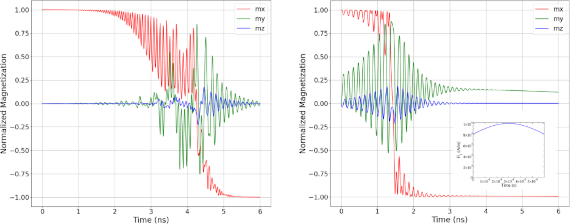
Fig. 1: (Left) Magnetization reversal from a parallel to an anti-parallel state without external magnetic field. (Right) Magnetic field accelerated reversal. (Inset) Time-dependent magnetic field pulse.