


 |
|
||||
BiographyBernhard Pruckner was born in 1994 in Vienna. He received his BSc degree in Technical Physics at the TU Wien in 2017. After completing his BSc degree, Bernhard was offered an exchange internship at Instituto Superior Tecnico in Lisbon where he was modeling laser-plasma interactions using a finite difference method. He continued his study at the TU Wien simultaneously working on his Master thesis at the Austrian Institute of Technology on coupled finite volume - finite element approach for simulating solidification processes in aluminum alloys. He successfully defended the thesis at the TU Wien in 2020 and received his Masters degree in Technical Physics. After working at the Division of Nuclear Medicine at AKH Wien he joined the Institute for Microeletronics in December 2022, where he is pursuing a PhD degree in micromagnetic simulations for non-volatile magnetic memory devices. |
|||||

Spin Polarization and Switching Dynamics of the Noncollinear Antifferromagnet Mn$_3$Sn
Noncollinear antiferromagnets (nc-AFMs) like Mn3Sn have emerged as promising candidates for spin-polarizing layers in next-generation spin orbit torque magnetoresistive memory RAM (SOT-MRAM) devices. Mn3Sn exhibits the magnetic spin Hall effect (MSHE), which leads to the generation of out-of-plane polarized spin currents from an in-plane charge current. The integration of Mn3Sn into SOT-MRAM cells, facilitates field-free perpendicular magnetization switching, eliminating the need for an externally applied magnetic field.
In addition, Mn3Sn can potentially be used as a magnetic memory layer, due to its spin structure, where the Mn atoms, carrying the 3 magnetic sub-moments, are arranged in a two-dimensional Kagome lattice. Tensile strain breaks the crystal symmetry, introducing a small net magnetic moment mnet. High strain leads to two distinct energy minima, corresponding to a stable 'up' and 'down' state of mnet. Applying an external magnetic field shifts the energy barriers, facilitating deterministic switching.
The MSHE can be fully electrically controlled by switching the magnetic orientation of Mn3Sn in a Mn3Sn/Mo/CoFeB trilayer structure (Fig 1a). Applying a charge current IMSHE in x-direction leads to the switching of mFM of the CoFeB layer by the MSHE. Further applying IAFM > IMSHE to the structure leads to, in turn, the switching of mnet by spin-polarized current leaking from the CoFeB layer into the Mn3Sn layer. The Oersted field generated by a charge current in the Mo layer, is sufficient to enable deterministic switching of the Mn3Sn layer by shifting the energy barriers (Fig 1b). This scheme shows the pathway to additional control over MSHE-induced switching in future SOT-MRAM.
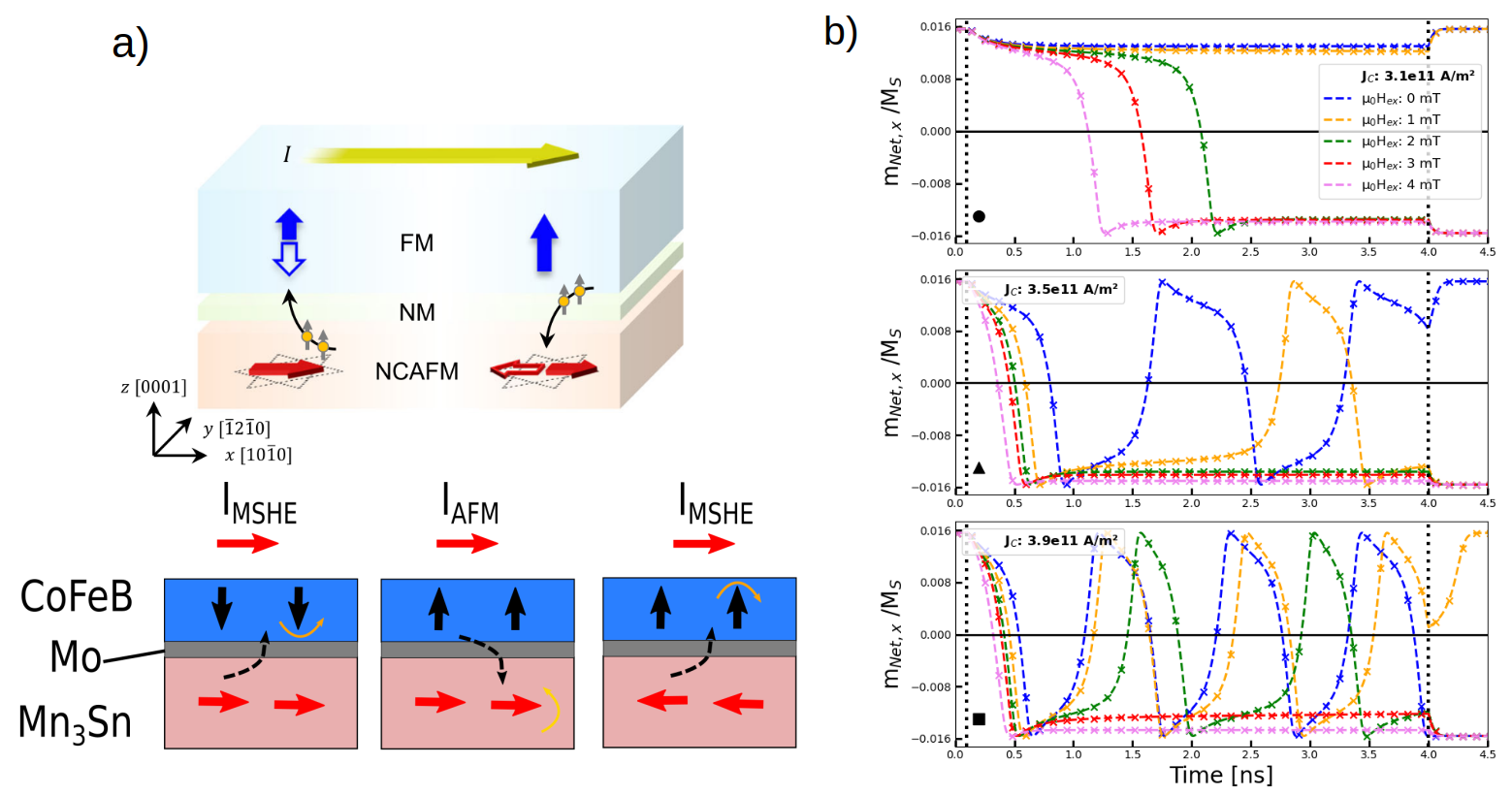
Fig. 1: a) top: Trilayer structure of the mutual switching device in. Red and blue arrows indicate the orientation of mnet of the nc-AFM, and mFM of the FM respectively. bottom: Switching scheme: Red and black arrows indicate mnet and mFM, dotted black arrows indicate the flow of spin current, and orange arrows indicate the rotation of the magnetic moments due to spin torque. The charge currents IMSHE and IAFM are applied in x-direction. b) The x-component of mnet of Mn3Sn for the different applied charge current densities jC and external fields. Current is applied from 0.1 to 4 ns.