


 |
|
||||
BiographyJosef Salzmann was born in 1997 in Feldkirch, Austria. He received both his BSc degree and his Diplomingenieur in Computer Engineering from TU Wien. During his studies, he also worked as a research assistant at the Institute of Computer Engineering. In August 2024, he joined the Institute for Microelectronics, where he works on the development of computer models to simulation the impact of charge trapping effects integrated circuits. |
|||||

Incorporating non-radiative multi-phonon model into SPICE
Metal-oxide-semiconductors suffer from imperfections at the atomic level, referred to as defects, which affect their electrical properties, impairing their performance and lifetime. Non-radiative multi-phonon theory (NMP) captures the behaviour of these defects and allows their prediction. In this work we aim to incorporate NMP into SPICE models to perform SPICE simulations that allow the analysis of arbitrary circuits with respect to the defect behaviour of the respective transistors. This will be achieved by adding an XSPICE code model that implements the behaviour of a defect according to NMP to ngspice, the open source version of SPICE.
Using the effective single defect decomposition (ESiD), defect parameters are extracted from measure-stress-measure sequences. Additionally, CV and IDVG curves will be fitted to obtain a SPICE model that captures the electrical properties and defect behaviour of a given transistor, see Fig. 1. Since calculations of the defect behaviour in NMP are computationally expensive, especially for transient simulation, an efficient implementation of the defect model is needed to allow simulation of circuits with each transistor having up to hundreds or thousands of defects. This addition to ngpsice will enable a more thorough analysis of the behaviour of circuits consisting of transistors containing defects.
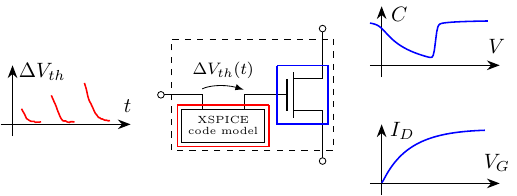
Fig. 1: SPICE Model Parameterization