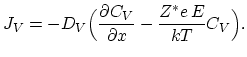
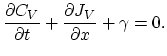
Interconnect reliability due to thermal effects is becoming a serious design issue particularly for dense packed interconnect structures. Thermal effects are inseparable aspects of electrical power distribution and signal transmission through the interconnects due to self-heating caused by the flow of current. Thermal expansion mismatch between the metal and the passivation layer causes stress which leads to fatigue and failure of the metalization [2]. The first problem to be modeled is self-heating due to an electrical current, which is described by the following equations [76],
 represents the material specific thermal conductivity,
  is the electrical condutivity,
  is the electrical power loss density,
  is the specific heat, and
  is the mass density.
As solution we get the temperature distribution in the interconnect, barrier, and passivation layers.
is the mass density.
As solution we get the temperature distribution in the interconnect, barrier, and passivation layers.
In each electromigration model discussed below, the effect of electromigration is proportional to current density. Most of the available TCAD electromigration reliability tools [65,68] are exclusively based on current density simulation.
One of the well established results is that the current density exponent  in Black's equation is caused by significant Joule self-heating at high current densities [7].