


 |
|
||||
BiographyPaul Manstetten was born in Berlin, Germany. He studied Mechatronics at the University of Applied Sciences Regensburg (Dipl.-Ing.) and Computational Engineering at the University of Erlangen-Nuremberg (MSc). After three years as an application engineer for optical simulations at OSRAM Opto Semiconductors in Regensburg, he joined the Institute for Microelectronics in 2015 as a project assistant. He finished his PhD studies (Dr.techn.) in 2018 and was employed as a postdoctoral researcher on high performance computing methods for semiconductor process simulations until 2022. Starting 2019, his activities include teaching assignments with a focus on C/C++ and numerical methods for scientific computing. Currently, his main focus is supporting the restructuring and expansion of the bachelor's program Electrical Engineering and Information Technology w.r.t. the programming lectures lead by the Institute for Microelectronics. |
|||||

Notebook-based learning material for modern C++
Utilizing Jupyter Notebooks is currently the dominant choice when preparing and providing lecture material and exercise handouts for Python-based programming classes; these notebooks enable
- interleaving of documentation with code snippets,
- formatting of documentation using Markdown (including Latex-compatible rendering of formulas) and code highlighting,
- interactive execution of code cells,
- interactive display of results,
- single-file distribution requiring only a web-browser and some common python packages on the host.
The institute's programming lectures cover Python but also C++/C: to enable a similar notebook-based setup for lecture material and exercise handouts for modern C++, we developed a notebook-kernel for C++ based directly on the interactive C++ REPL-prompt called clang-repl which is part of the LLVM project.
In contrast to existing solutions (cling, xeus-clang-repl) our kernel
- allows using modern standards (C++23/C++26) as far as implemented for the clang compiler and standard library present on the host,
- does not require a patched LLVM build but works with the official releases available via the package manager on the host,
- allows adaption of compiler options and to create default includes and library loads via a configuration file.
The figure below shows an example notebook performing a parallel initialization of a vector and the corresponding configuration file setting up the required compiler flags, includes, and linking.
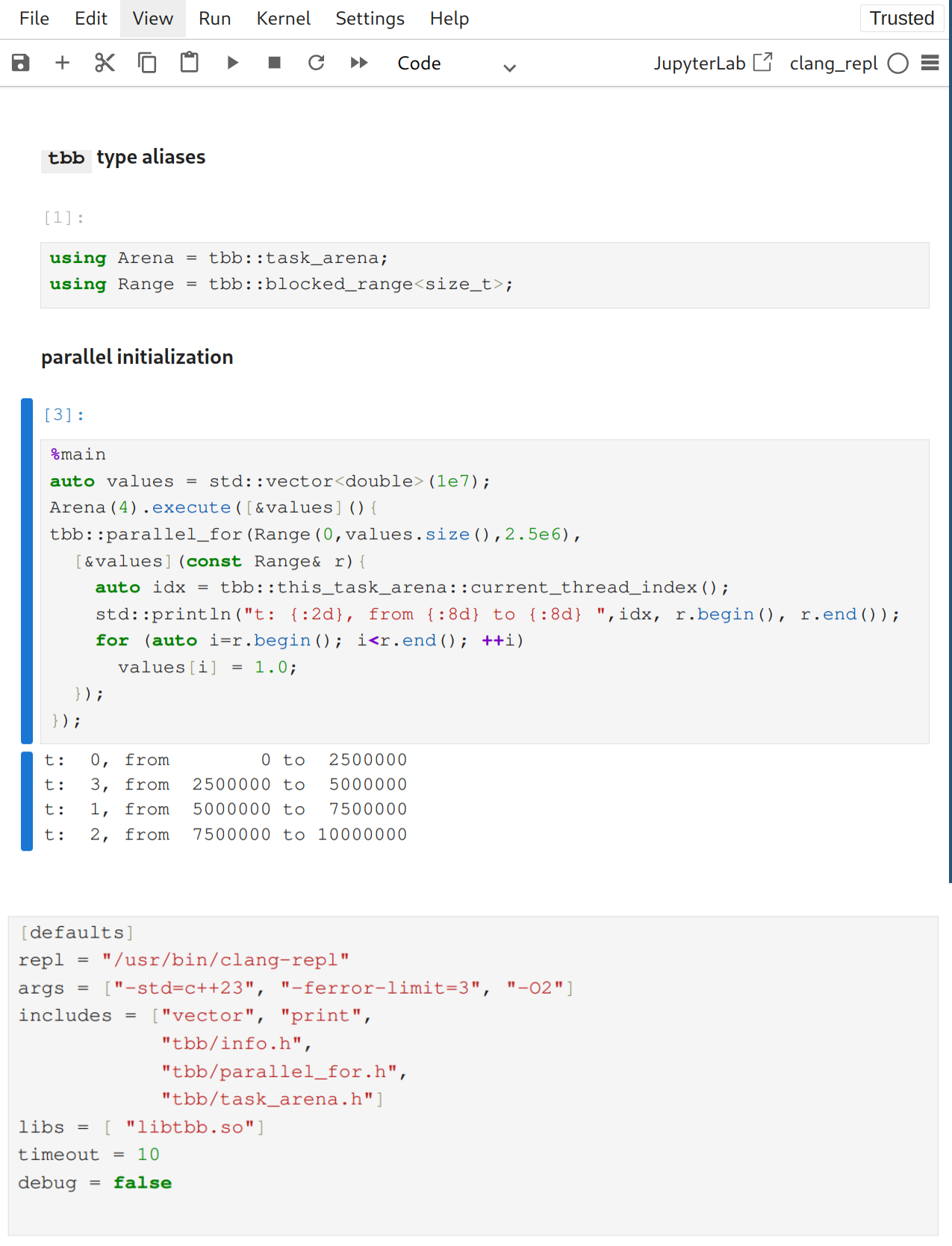
Fig. 1: Top: Example notebook showing an interactive notebook performing a parallel initialization using the TBB library and displaying some results. Bottom: corresponding configuration file defining the REPL-prompt executable, compiler arguments, names of headers to include, and libraries to be loaded.