

 |
|
||||
BiographyBernhard Stampfer, born in 1989 in Austria, studied at the Technische Universität Wien where he received the Bachelor’s degree (BSc) in Electrical Engineering (2013), the Diplomingenieur degree (Dipl.-Ing., MSc equivalent) in Microelectronics and Photonics (2016) and the Doctoral degree (Dr.techn., PhD equivalent) in 2020. Bernhard is employed at the Institute for Microelectronics as a post-doctoral researcher and his work is focused on the characterization of defects in semiconductor devices. |
|||||

Challenges in Intermediate Frequency IV Characterizations
One of the standard methods for characterizing field-effect transistors is current-voltage (IV) characterization. In this relatively simple method, the voltage at the gate terminal of the transistor (VG) is ramped while the drain-source current (ID) is recorded. This is done slowly enough to capture the static behavior of the device.
In contrast, another popular method is capacitance-voltage (CV) characterization. Here, a relatively high-frequency bias (>=100kHz) is applied to the gate to record capacitive displacement currents, while static currents are filtered out.
In a more advanced approach, IV-like voltage sweeps at varying ramp speeds can be used to capture time-dependent device effects, such as charge trapping in defects or the movement of mobile ions—so-called hysteresis measurements. One way to increase the information gained from such measurements is to expand the range of sweep frequencies, both to lower and higher values.
Extending the range to lower frequencies is usually not challenging, though it can be limited by the total measurement time available. Increasing the frequencies toward the intermediate frequency range—between standard IV and CV measurements—is more difficult. Undesired effects (at least for this type of measurement), such as the aforementioned displacement currents as well as temporal limitations of the measurement equipment due to its frequency response (normally negligible in IV-type measurements), become significant and distort the measured currents, potentially leading to misleading results. Mitigating—or, if not possible, properly accounting for—these effects is therefore essential to maximize the usefulness of such measurements and the physical insights that can be gained.
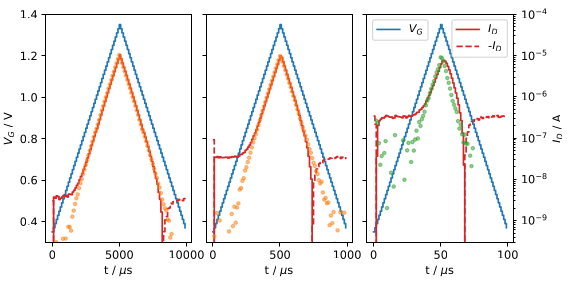
Fig. 1: Intermediate frequency IV measurements (lines) and corrected currents (dots). Left: 100 Hz, the displacement current is visible with a magnitude of around 3 fA. Middle: 1 kHz, the displacement current increases linearly with frequency. Right: At 10 kHz, equipment limitations become significant, causing a delay and rounding compared to the ideal waveform. Orange: displacement current corrected. Green: displacement current and frequency response corrected. Note the higher noise level resulting from decreased integration time.