


Here we use the vacancy-only model (Section 3.3.3) in combination with the segregation model (Section 3.5.3) to simulate the behavior of phosphorus dopants in the vicinity of the silicon/silicon-dioxide interface.
The extrinsic phosphorus diffusivity is modeled according to [6] assuming that phosphorus atoms diffuse with neutral and negatively charged vacancies,
![$\displaystyle D_{P}=\Bigl[3.85 e^{-3.66 \text{eV}/kT} + 4.44 \Bigl(\frac{n...
....2\Bigl(\frac{n}{n_i} \Bigr)^2 e^{-4.37 \text{eV}/kT}\Bigr] \text{cm}^2/s.$](img696.png) |
(210) |
The extrinsic concentration of the electrons 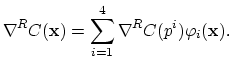 is calculated using (3.13).
The considered MOSFET structure is displayed on Figure 3.3. An initial phosphorus profile is calculated by means of implatation with a dosis
 cm
cm and energy
  keV (Figure 3.4).
The ion-implantation simulation is carried out with the simulator MCIMPL-II [39,40].
keV (Figure 3.4).
The ion-implantation simulation is carried out with the simulator MCIMPL-II [39,40].
|
|
|
The mesh used for the simulation is presented in Figure 3.5. Since we have expected higher gradients of dopant concentration in the vicinity of silicon/silicon-dioxide interface the simulation mesh is refined in this area with increased number of points in the direction ortoghonal on the silicon/silicon-dioxide interface.
After a diffusion time of  min the dopants have spread deeper into the silicon bulk and penetrated into silicon-dioxide, as can be seen from the Figure 3.7.
The characteristic pileup in the vicinity of the silicon/silicon-dioxide interface can be observed on the basis of the behavior of maximal phosphorus concentration flux and flux error, calculated on the basis of discussion presented in Section 2.9. A pileup effect, as part of the segregation of dopants on the silicon/silicon-dioxide interfaces, is regularly observed in experiments [41,42,43].
For comparison the simulation is carried out with and without the segregation model. The diffusion conditions at the silicon/silicon-dioxide interface produce from the very beginning distinctively higher concentration gradients. The curves presented in Figure 3.6a are normalized to the maximum concentration gradient in the case where no segregation model is applied. The presence of the silicon/silicon-dioxide interface causes a more than 2.4 times larger phosphorus concentration gradient. However, due to a carefully chosen mesh (Figure 3.5) no significant increase of the flux error is observed.
 .
.![$\textstyle \parbox{5cm}{
\vspace*{2.2cm}
$1.28 \cdot 10^{13}$\ [6mm]
$9.60 ...
... 10^{12}$\ [6mm]
$3.20 \cdot 10^{12}$\ [6mm]
$1.00 \cdot 10^{6}$\ [6mm]
}$](img702.png)