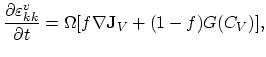
The coupling of the vacancy dynamics with the stress development was first introduced by Korhonen in [51]. The analysis was carried out for a passivated straight aluminum interconnect line with a columnar grain structure with the grain boundaries perpendicular to the substrate. The author assumes that vacancy diffusion along grain boundaries equilibrates the stress in such a way that it reduces to a hydrostatic state on a time scale that is short compared to that for long range diffusion along the entire line length. The recombination and generation of vacancies changes the concentration of the available lattice sites, which consequently influences the hydrostatic stress distribution. Specifically, the loss of the available lattice sites yields an increase of the hydrostatic stress.
This assumption greatly simplifies the analysis und allows an analytical solution of the governing equation. However, this approach is eglible only for passivated straight interconnects with a specific aluminum crystal texture.
Metal self-diffusion occurs via a vacancy exchange mechanism. The atomic flux
 is equal and opposite the flux of vacancies
 . Therefore, the electromigration induced vacancy flux resulting from an applied electric field
 is given by [51],
 ,
,  and
and  , are the concentration and diffusion coefficient of atoms and vacancies, respectively.
  is the effective valence (Section 4.2).
 and the effective diffusion coefficient are related,
 is the grain boundary width and
  is the grain size. As it was shown by Herring [78,79], diffusive fluxes of atoms (vacancies) arise due to potential differences between different locations of the interconnect line and the chemical potential given by,
 is the atomic volume, and
  is the tensile stress normal to the grain boundary or the interface.
One of the basic assumptions made by Korhonen [51], is that electromigration will deposit atoms in grain boundaries in such a way that mechanical stress very fast becames uniform (compared with the self-diffusion along the interconnect) at a any particular cross section of straight interconnect (perpendicular to the electrical current direction). This assumption significantly simplifies analysis because the mechanical stress gradient is non-zero only in the electrical current direction where it opposites electromigration.
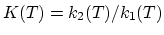
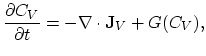
The model transport equations can be expressed in terms of either vacancies or atoms but in most cases [51] vacancy are chosen. The net vacancy flux along the length of the interconnect line induced by the gradient of the chemical potential and electromigration, taking into account (4.16) can be written as,
 is a sink/source term which models the recombination or generation of vacancies at sites such as grain boundaries, lattice dislocations, or surfaces. Combining (4.19) and (4.20) we obtain Korhonen's equation,
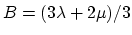 to model the build-up of vacancies at the end of a semi-infinite line.
Instead of an intermediate relationship between the density of lattice sites and hydrostatic stress other researchers [81,82] employed the idea that the vacancy diffusion flux gives rise to volumetric strain which serves to establish stress fields, driving stress migration fluxes. This approach is utilized in [70]. The main advantage is that one does not need the assumption of local stress-vacancy equilibrium, the elastic behavior of metal is not required, and most important, all components of the stress tensor are included. Thus arbitrary geometric shapes in connection with the complex mechanical boundary conditions can be investigated.

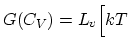
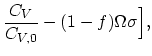

 exp
exp