


In the case of copper interconnects there are several types of vacancy diffusivities of importance, namely, diffusion in the bulk material, grain boundary diffusion, the diffusion along the copper/barrier interfaces, and the diffusion along copper/cap-layer interface.
The bulk diffusion coefficient can be neglected for temperatures well below the melting point [55].
The simpliest way to take into account all diffusivities is by introducing an effective diffusion coefficient dependent on the diffusivity coefficients of all paths and on microstructural parameters such as grain size and grain boundary thickness [77].
Since most copper grains in a Damascene lines are not larger than 0.3  m the majority of the interconnects used today will inevitably have a bamboo structure, so that averaging in the sense of an effective diffusion coefficient is feasible.
However, fast diffusivity paths along copper/barrier and copper/cap-layer interfaces will influence the vacancy dynamics strongly depending on the specific interconnect layout.
This influence can not be incorporated with simple averaging terms. The diffusivity must be a cumulative value as used in [55]
m the majority of the interconnects used today will inevitably have a bamboo structure, so that averaging in the sense of an effective diffusion coefficient is feasible.
However, fast diffusivity paths along copper/barrier and copper/cap-layer interfaces will influence the vacancy dynamics strongly depending on the specific interconnect layout.
This influence can not be incorporated with simple averaging terms. The diffusivity must be a cumulative value as used in [55]
 ,
, 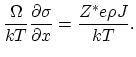 ,
, 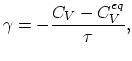 , and
, and  , represent the diffusivity through the bulk, along the grain boundaries, copper/barrier interfaces, and copper/caplayer interfaces, respectively.
 is the width of the grain boundary and
  the average length of a grain boundary. Coefficients
 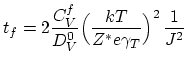 and
and  depend only on the layout geometry.
To predict the location of the void nucleation sites and the time needed for a void to nucleate a multitude of microstructural, chemical, process-related, and environment-related variables have to be taken into account.
The microstructural characteristics which need to be considered are the grain boundary structure and the orientation of the crystal axes inside the grains.
Numerous experiments [55,8] have shown that the design of the interconnect, passivation, and barrier layers, together with the material composition of these layers, has a significant impact
on the localization of void nucleation sites.
Of crucial importance for the void-nucleating condition are the dynamics of the crystal vacancies of the interconnect metal. Depending on crystal texture of the used copper interconnect and it's geometry there are several possible paths for the vacancy diffusion.

