


The equations (4.50)-(4.52) are solved by means of the finite element method on a
sequence of the grids
 each one adapted to the position of the
void-metal interface from the previous time step. The initial grid
each one adapted to the position of the
void-metal interface from the previous time step. The initial grid
 is produced by refinement of some basic triangulation
 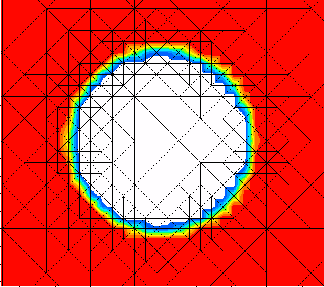 of area
  according to the initial profile of order parameter
  .
The motivation of grid adaptation is to construct and maintain a fine
triangulated belt of width
.
The motivation of grid adaptation is to construct and maintain a fine
triangulated belt of width
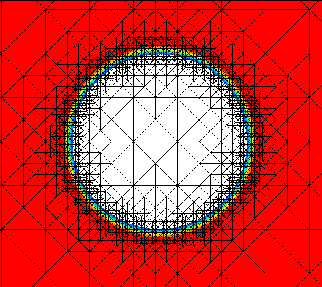 in the interconnect area
where
in the interconnect area
where
 , respectively, where the void-metal interface area is placed.