2.1.3 Extended-Measurement-Stress-Measurement Setup
To save on time and devices when performing NBTI experiments the
extended-MSM (eMSM) measurement routine was established [18]. Choosing
each stress sequence  to be significantly longer than the previous
stress sequence
to be significantly longer than the previous
stress sequence  ensures that the amount of degradation lost during
the recovery within
ensures that the amount of degradation lost during
the recovery within  is nearly completely restored within
  .
Consequently, regardless if the stress is interrupted or not, more or less the
same amount of degradation is obtained after the total stress time, i.e.
.
Consequently, regardless if the stress is interrupted or not, more or less the
same amount of degradation is obtained after the total stress time, i.e.
 . This is schematically depicted in Fig. 2.3, where
the top dotted black line of the continuous degradation is always met by the
individual sub-sequences (red dotted lines) of the eMSM-sequence after
sufficiently long stresses. When the stress sequences are recorded via the
on-the-fly method, which will be explained in Chapter 2.3, both stress and
recovery can be monitored with the eMSM routine.
. This is schematically depicted in Fig. 2.3, where
the top dotted black line of the continuous degradation is always met by the
individual sub-sequences (red dotted lines) of the eMSM-sequence after
sufficiently long stresses. When the stress sequences are recorded via the
on-the-fly method, which will be explained in Chapter 2.3, both stress and
recovery can be monitored with the eMSM routine.
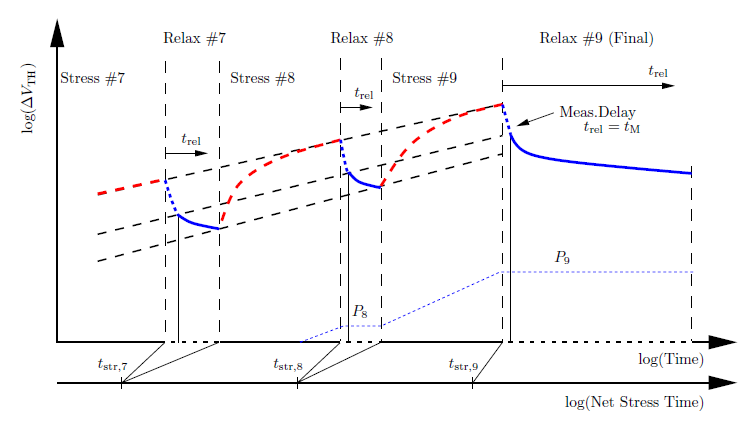
 stress/relaxation
cycles building up an eMSM-sequence like performed by
stress/relaxation
cycles building up an eMSM-sequence like performed by  times to record
  short and one
long final relaxation sequence on the relative time scales
short and one
long final relaxation sequence on the relative time scales  .
After the measurement delay
.
After the measurement delay  marked by the dashed blue lines the
monitorable relaxation (solid blue) sets in. A permanent or slowly relaxing
component
marked by the dashed blue lines the
monitorable relaxation (solid blue) sets in. A permanent or slowly relaxing
component  is indicated for the last two cycles and will be explained in
Chapter
is indicated for the last two cycles and will be explained in
Chapter