4.2.1 Temperature and Voltage Dependence of Universal Law
Up to now it was only shown that the universality holds for various
pMOS/nMOS-NBTI/PBTI-combinations. As temperature and voltage
acceleration play an important role for lifetime projection, the study of the
universal relaxation is now extended towards these stress conditions. How the
two components  and
and  behave is therefore analyzed under different stress
temperatures
behave is therefore analyzed under different stress
temperatures  and stress voltages
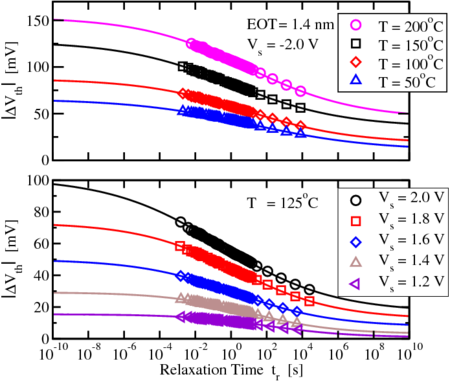
  , cf. Fig. 4.7. In this graph only the last
long relaxation tail of the MSM-sequence is depicted. The different stress
conditions described by the relaxation model (4.5) yield excellent agreement with
the measurement results. The activation energies
, cf. Fig. 4.7. In this graph only the last
long relaxation tail of the MSM-sequence is depicted. The different stress
conditions described by the relaxation model (4.5) yield excellent agreement with
the measurement results. The activation energies  are extracted for
  and
and
 , and the components of
  and
and  . They are depicted in Fig. 4.8.
While
. They are depicted in Fig. 4.8.
While  and
and  show an Arrhenius-like behavior with
  respectively
  for different stress times,
  is constant.
  on the other
hand depends on the stress time, which rules out Arrhenius-like behavior
[6, 30].
on the other
hand depends on the stress time, which rules out Arrhenius-like behavior
[6, 30].
 stress is
considered under various temperatures (
stress is
considered under various temperatures (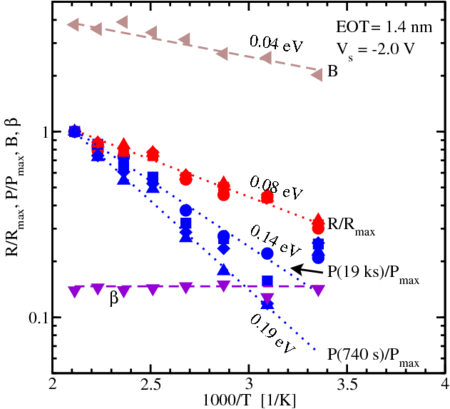
 ,
,  ,
,
 , and
, and  in our relaxation model (
 and
and  are Arrhenius,
 is not (due to different values of
  ), and
  is constant.