


The two-dimensioanl case leads to a linear equation system similar to
(5.37). The sub-matrix ![$ [A]$](img445.gif) is
written in the form (5.67). With
is
written in the form (5.67). With  constant in each element
 ![$ [S]^e$](img554.gif) is given by
is given by
![\begin{displaymath}\begin{split}S_{ij}^e & = \frac{1}{\gamma}\int_{\mathcal{A}_e...
...times\vec{N}_j^e\right)F_e, i\in[1;3], j\in[1;3], \end{split}\end{displaymath}](img555.gif) |
(5.82) |
 |
(5.83) |
 |
(5.84) |
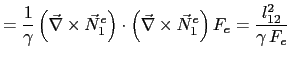
Thus
becomes
 |
 |
(5.85) |
 |
 |
(5.86) |
 |
 |
(5.87) |
 |
 |
(5.88) |
 |
 |
(5.89) |
 |
 |
(5.90) |
For element-wise constant  the entries from
 ![$ [M]^e$](img277.gif) are obtained from
are obtained from
![$\displaystyle M_{ij}^e = \mu\int_{\mathcal{A}_e}\vec{N}_i^e\cdot\vec{N}_j^e \mathrm{d}A, i\in[1;3], j\in[1;3].$](img570.gif) |
(5.91) |
![\begin{displaymath}\begin{split}M_{11}^e & = \mu\int_{\mathcal{A}_e}\vec{N}_1^e\...
..._e}\left(\lambda_2^e\right)^2 \mathrm{d}A \right]. \end{split}\end{displaymath}](img571.gif) |
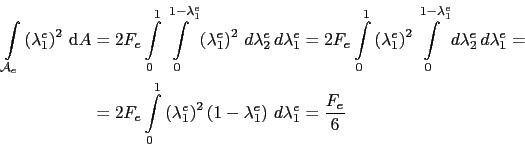
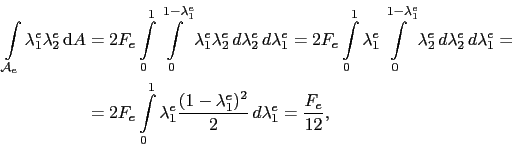
The arrising integrals are solved as follows
 |
(5.92) |
 |
(5.93) |
using the integral domain transformation Appendix A. Generally it can be written
![$\displaystyle \int_{\mathcal{A}_e}\lambda_i^e\lambda_j^e \mathrm{d}A = \left\{...
...}{12} & \mathrm{for} i \neq j \end{array} \right. j\in[1;3], j\in[1;3].$](img574.gif) |
(5.94) |
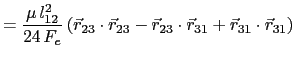
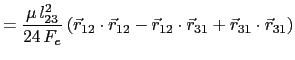
In a similar manner all entries of
are given
 |
 |
(5.95) |
 |
 |
(5.96) |
 |
 |
(5.97) |
 |
 |
(5.98) |
 |
 |
(5.99) |
 |
 |
(5.100) |
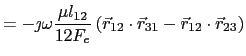
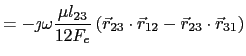
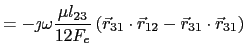
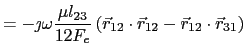
The entries of ![$ [B]$](img446.gif) are expressed as
are expressed as
![$\displaystyle B_{ij}^e = - \jmath\omega\mu\int_{\mathcal{A}_e}\vec{N}_i^e\cdot\vec{\nabla}\lambda_j^e \mathrm{d}A, i\in[1;3], j\in[1;3].$](img587.gif) |
(5.101) |
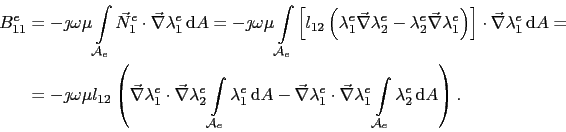
The entry  is calculated in detail as
 |
(5.102) |
For the integral terms the integral domain transformation from Appendix A is used again to obtain
![$\displaystyle \int_{\mathcal{A}_e}\lambda_i^e \mathrm{d}A = \frac{F_e}{3}, i\in[1;3].$](img590.gif) |
(5.103) |
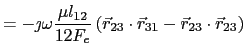
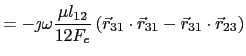
Thus ![$ [B]^e$](img591.gif) is given by
is given by
 |
 |
(5.104) |
 |
||
 |
 |
(5.105) |
 |
 |
(5.106) |
 |
 |
(5.107) |
 |
 |
(5.108) |
 |
 |
(5.109) |
 |
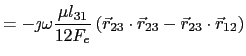 |
(5.110) |
 |
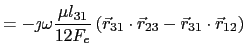 |
(5.111) |
 |
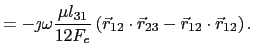 |
(5.112) |
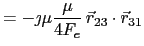
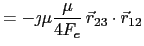
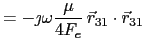
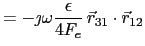
Analogously to (4.49)
for the element matrix
![$ \left[C\right]^e$](img611.gif) one obtains:
one obtains:
 |
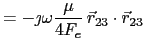 |
(5.113) |
 |
 |
(5.114) |
 |
 |
(5.115) |
 |
 |
(5.116) |
 |
 |
(5.117) |
 |
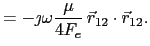 |
(5.118) |