


The discretization of the simple diffusion models follows directly from the discussion presented in Section 2.3. In order to construct the global matrix of the system, we write nucleus matrix of the simple diffusion model for each
 ,
,
 ,
,
 is the time step of the discretisized time and
 and
and
 the stiffness and mass matrices defined on single tetrahedra
  from
from
 ,
,
 |
|||
 |
(140) |
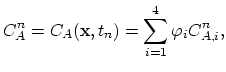 . This problem is linear and the calculation of the nucleus matrix
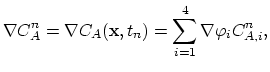 as the Jacobi matrix of the operator
 (introduced previously in Section 2.5) is trivial.
 is assembled out of the
matrices and has obviosly a dimension equal to the number of all points of discretization.
is assembled out of the
matrices and has obviosly a dimension equal to the number of all points of discretization.
