


In order to study electromigration effects in modern copper-based interconnect layouts we have to deal with two types of models which are needed because of the different character of the physical phenomena taking place in the void pre-nucleating and void evolution phase.
We denote as 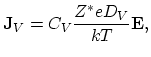 the time needed for the void to nucleate and as
 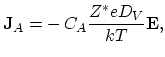 the time which a nucleated void needs to grow from some initial nucleation size to the size which changes the interconnect resistivity to such an extent that it practically fails (for example
 ).
So we can calculate the time to failure of the interconnect line,
).
So we can calculate the time to failure of the interconnect line,
 |
(214) |