


An initial void with some small radius  is placed at some characteristic position inside the three-dimensional interconnect structure (Figure 4.15). Since most of the fatal voids are nucleated in the vicinity or in the area of interconnect vias we consider in particular these cases. The configurable initial void volume is
  which is smaller than
 because the void area is confined by sphere and boundary of the interconnect (Figure 4.15).
Starting from the initial void radius , the void radius is gradually incremented
because the void area is confined by sphere and boundary of the interconnect (Figure 4.15).
Starting from the initial void radius , the void radius is gradually incremented
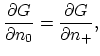 , with
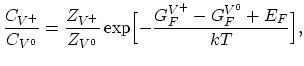 .
For each void radius the electrical field in the interconnect structure is calculated by means of the finite element method using a diffuse interface approach.
To obtain the distribution of the electrical potential inside the interconnects the Poisson equation (4.52) has to be solved.
.
For each void radius the electrical field in the interconnect structure is calculated by means of the finite element method using a diffuse interface approach.
To obtain the distribution of the electrical potential inside the interconnects the Poisson equation (4.52) has to be solved.
In order to obtain sufficient accuracy the scalar field
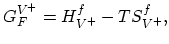 must be resolved on a locally refined mesh (Figure 4.16).
For an electrical field calculated in such a way, the resistance of the interconnect via is also calculated [76,91]. With growing void size the resistance increases. The whole process is stopped when a void radius is reached for which
must be resolved on a locally refined mesh (Figure 4.16).
For an electrical field calculated in such a way, the resistance of the interconnect via is also calculated [76,91]. With growing void size the resistance increases. The whole process is stopped when a void radius is reached for which
 .
.
The primary driving force of material transport at the void surface is electromigration proportional to the tangent component of the vector current density. Since the diffuse interface approach for the calculation of the current density ensures physical behavior of the electrical field in the vicinity of the isolating void, the normal component of the current density on the void surface is always zero and we can apply the formula
 . (4.63) expresses the averaging of the current density weighted with finite element volume inside the interconnect. Since
 in metal and
 in the void area, the term
 is non-zero only in void-metal interface area.
|
|
The evolution of the void is caused by material transport on the void surface and in the vicinity of the void surface. The mass conservation law gives the mean propagation velocity  of the evolving void-metal interface
 is the vacancy diffusivity and
  effective charge number of vacancies. (4.64) is valid for all void shapes.
As we can see from Figure 4.17, the average current density on the void surface increases with the void size. Both, current density and resistance, exhibit a very similar dynamic behavior. The dynamical resistance increase is in accordance with the measurement results presented in [52]. Compared with the earlier result [92], which assumes cubical void shapes, our approach enables more realistic simulations. An open question is how to use the obtained average current density (Figure 4.17) for the estimation of the void growing time (
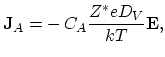 ) up to the critical void size.
In [92] a simple formula is applied
) up to the critical void size.
In [92] a simple formula is applied
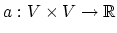 is the critical void size, is the initial void size,
  is the cross section of the interconnect in the vicinity of the growing void, and
  is the mean velocity of the evolving void-metal interface.
However, this formula is only valid in the case of cubical void which is a very rough approximation of the real situation.
According to newer experimental results [8] the real void shape is significantly better approximated by a spherical sector.
In this case can be estimated as
is the mean velocity of the evolving void-metal interface.
However, this formula is only valid in the case of cubical void which is a very rough approximation of the real situation.
According to newer experimental results [8] the real void shape is significantly better approximated by a spherical sector.
In this case can be estimated as
 , the void radius grows from to
  with a constant velocity .
As we can see from (
 ), the velocity depends on the vacancy diffusivity which itself has significantly varying values depending on the diffusion path.
The electromigration assisted self-diffusion of copper is a complex process which includes simultaneous diffusion through the crystal bulk, along grain boundaries, along the copper/barrier interfaces, and along the copper/cap-layer interface.
Therefore, the diffusivity applied in (
), the velocity depends on the vacancy diffusivity which itself has significantly varying values depending on the diffusion path.
The electromigration assisted self-diffusion of copper is a complex process which includes simultaneous diffusion through the crystal bulk, along grain boundaries, along the copper/barrier interfaces, and along the copper/cap-layer interface.
Therefore, the diffusivity applied in (
 ) must be a cumulative value (see equation 4.12).
For a feasible estimation of , reliable, experimentally determined values for all relevant diffusivities are needed and these are until now unfortunately not available [55,8].
) must be a cumulative value (see equation 4.12).
For a feasible estimation of , reliable, experimentally determined values for all relevant diffusivities are needed and these are until now unfortunately not available [55,8].
![$\displaystyle J_{m,i}=2\frac{\int_{V}\Vert\mathbf{J}\Vert[1-\phi^2_i(x,y,z)] dV}{\int_{V}[1-\phi^2_i(x,y,z)] dV},$](img958.png)


