 d∕dy of a
misfit dislocation at the interface between a film with a finite thickness and a semi-infinite
substrate. The film and the substrate are both supposed to be isotropic but with different
elastic properties.
d∕dy of a
misfit dislocation at the interface between a film with a finite thickness and a semi-infinite
substrate. The film and the substrate are both supposed to be isotropic but with different
elastic properties.
Willis, Jain, and Bullough [82] derived a procedure to calculate the energy dd∕dy of a
misfit dislocation at the interface between a film with a finite thickness and a semi-infinite
substrate. The film and the substrate are both supposed to be isotropic but with different
elastic properties.
Figure 4.9 shows two sets of curves representing dd∕dy as a function of the
film thickness for three different systems: Al0.2Ga0.8N film on a GaN substrate,
In0.2Ga0.8N on GaN, and a GaN film grown on a GaN substrate. One set of the dd∕dy
curves is calculated with the Willis et al. model, while the second uses the Freund
treatment. Therefore, the difference stems from including (Willis et al.) or neglecting
(F) the free surface effects and the difference in the elastic constants of the film
and the substrate. In both cases the isotropic elasticity framework is used. The
curves within each set are very close to each other, meaning that the impact of
different elastic properties of the film and the substrate is negligible for these
material systems. Therefore it can be concluded that the difference between the
two sets originates predominantly from the impact of free surface. This factor
significantly increases the dd∕dy term and, as a consequence, also the critical thickness
value.
Figure 4.10 shows a similar analysis for two different systems: a Si0.2Ge0.8 film
on a Si substrate and a Si film grown on a Si substrate. As in the case of the
III-nitrides, the variation caused by the different elastic properties of the film
and the substrate is negligible. On the other hand, the difference between the
Willis et al. and Freund formalism, which is now related predominantly to the
inclusion of the free surface, is significant. Therefore, also for silicon as a substrate the
free surface increases dd∕dy and, as a consequence, the critical thickness value.
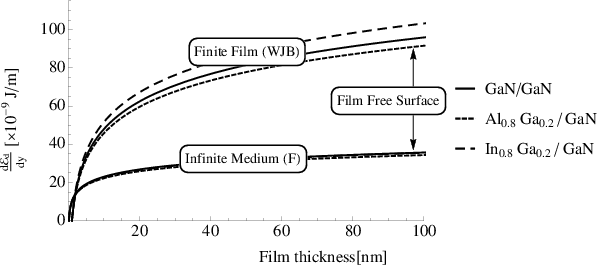
| Figure 4.9: | dd∕dy is a function of the film thickness for the material systems
AlxGa1-xN/GaN and InxGa1-xN/GaN. The ⟨113⟩{101} slip system is considered.
The two sets of curves are calculated through the Willis et al. (WJB) and Freund (F)
procedures, respectively. |
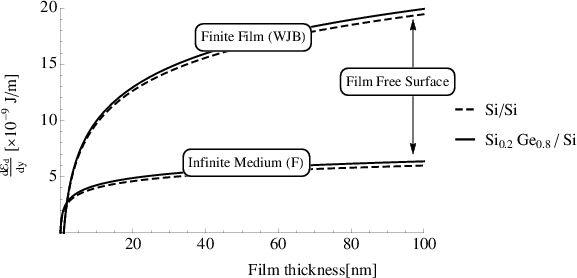
| Figure 4.10: | dd∕dy is a function of the film thickness for Si1-xGex/Si. The
⟨110⟩{111} slip system of a 60∘ dislocation is considered. The two sets of curves are
calculated through the Willis et al. (WJB) and Freund (F) procedures, respectively. |