 -characteristics of pMOSFETs
the understanding of the semiconductor charge
-characteristics of pMOSFETs
the understanding of the semiconductor charge  as a function of the surface
potential
as a function of the surface
potential  is inevitable. The nomenclature of these calacultions is based on
[10] but an n-type instead of a p-type semiconductor is used.
is inevitable. The nomenclature of these calacultions is based on
[10] but an n-type instead of a p-type semiconductor is used.
To be able to calculate and interpret the -characteristics of pMOSFETs
the understanding of the semiconductor charge as a function of the surface
potential is inevitable. The nomenclature of these calacultions is based on
[10] but an n-type instead of a p-type semiconductor is used.
The measure for the local band bending in the semiconductor is given by
 , which determines the local electron concentration
  and
hole concentration
and
hole concentration  given by
 and
and  denote the equilibrium densities (flatband case),
  the
Boltzmann constant and
the
Boltzmann constant and  the thermoelectrical potential at
  . Starting
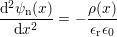
from the 1d-Poisson equation
. Starting
from the 1d-Poisson equation
 | (B.3) |
with the local space charge density  the
potential is obtained. Here,
the
potential is obtained. Here,  and
and  are the densities of the ionized
donors and acceptors. Deep in the substrate (and under flatband conditions in
the whole semiconductor) charge neutrality can be assumed
are the densities of the ionized
donors and acceptors. Deep in the substrate (and under flatband conditions in
the whole semiconductor) charge neutrality can be assumed  due
to
due
to  . Inserting and evaluating (B.1) and (B.2) yields
 and finally
 and
and
 to the surface with
  and
and  .
.
For non-degenerate semiconductors the Fermi level is far enough away from
 and
and  and Fermi-Dirac statistics can be approximated by Boltzmann
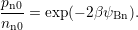
statistics. The carrier concentrations for an n-type semiconductor with
and Fermi-Dirac statistics can be approximated by Boltzmann
statistics. The carrier concentrations for an n-type semiconductor with
 can be approximated [10]. Then,
 | (B.10) |
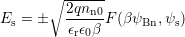
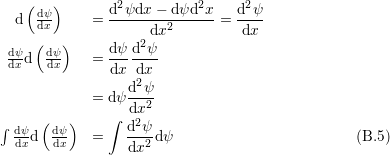
The electric field at the surface in (B.7) is now simplified to
 | (B.11) |
with
 | (B.12) |
By applying Gauss’ law  the space-charge-density per
area is finally obtained as
the space-charge-density per
area is finally obtained as
 | (B.13) |
For n-type (pMOS) semiconductors (B.13) can now be approximated for the
different regimes of the surface potential  with the contact voltage
  ,
defined in the beginning of the chapter. For accumulation with
,
defined in the beginning of the chapter. For accumulation with  , the term
 dominates in (B.12), making
 |
For  , depletion and successively weak inversion set in till
  is
fulfilled. Here
is
fulfilled. Here
 |
Finally, beyond  the first term in (B.12) starts to dominate, which
yields
the first term in (B.12) starts to dominate, which
yields
 |
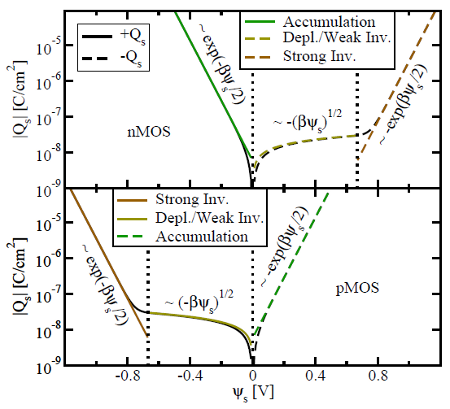
 compared for both p-type
and n-type semiconductors depending on
compared for both p-type
and n-type semiconductors depending on  . While the solid lines
stand for positive
. While the solid lines
stand for positive  , the dashed lines symbolize a negative
  . The
approximations very well fit the exact solutions (B.13) and (B.16) drawn in
black. Deviations from the latter only exist at the transitions of the operating
regimes. It is shown that
. The
approximations very well fit the exact solutions (B.13) and (B.16) drawn in
black. Deviations from the latter only exist at the transitions of the operating
regimes. It is shown that  , where the subscripts
  and
and  denote the type of semiconductor.


![∫ψs
−E∫sdψn (dψn) -q--
0 dx d dx = − ϵrϵ0(pn0(exp(− βψn) − 1)− nn0(exp(βψn )− 1))dψn
0
( )2||−Es q [ ( exp(− βψn) ) (exp (β ψn) )] ||ψs
12 ddψxn || = − ---- pn0 -----------− ψn − nn0 ---------− ψn || (B.6)
0 ϵrϵ0 [ ( − β ) ( β 0 ) ]
1E2 = − -q-- p exp(− β-ψs)− ψ + 1- − n exp(βψs)-− ψ − 1-
2 s ϵrϵ0 n0 − β s β n0 β s β
qn [( p ) ]
= ---n0 -n0- (exp(− βψs)+ β ψs − 1) + (exp(βψs)− β ψs − 1) (B.7.)
ϵrϵ0β nn0](diss2068x.png)
