
To approximately account for the above mentioned temperature and field activated tunneling process, a modified Shockley-Read-Hall (SRH) model4 is used within our device simulator Minimos-NT [89]. The SRH-capture-rates are multiplied by
|
| (5.2) |
where  is the electric field in the oxide,
  is a reference value,
  the multi-phonon emission barrier and
  the thermal energy.
  can be
characterized by a Gaussian distribution with the mean energy
can be
characterized by a Gaussian distribution with the mean energy  .
When setting the parameters some points need to be considered in order to end
up with a physically appropriate model:
.
When setting the parameters some points need to be considered in order to end
up with a physically appropriate model:
 due to the squared exponent,
leading to a very small range of valid
due to the squared exponent,
leading to a very small range of valid  values. This
  reference field acts as a scaling factor.
 determines the dependence of
  on
on
 . Increasing the mean of the distribution at
  increases
the mean capture/emission-time constants. Since with constant-slope
pulses higher pulse amplitudes
increases
the mean capture/emission-time constants. Since with constant-slope
pulses higher pulse amplitudes  require longer pulse durations,
increasing the mean
require longer pulse durations,
increasing the mean  shifts the point from which a significant
contribution of oxide traps
shifts the point from which a significant
contribution of oxide traps  can be observed to higher pulse
amplitudes. On the other hand, broadening the distribution of
can be observed to higher pulse
amplitudes. On the other hand, broadening the distribution of  (increasing the variance) also broadens the distribution of time
constants, observable as broadening the range of
(increasing the variance) also broadens the distribution of time
constants, observable as broadening the range of  where
where  increases.
 -signal in each time-interval of the pulse. To
achieve a smooth quadratic behavior as observed in the experiments,
Fig. 5.18, a broad Gaussian peak over a wide range of energies is
required (
-signal in each time-interval of the pulse. To
achieve a smooth quadratic behavior as observed in the experiments,
Fig. 5.18, a broad Gaussian peak over a wide range of energies is
required ( ), consistent with other
NBTI experiments [98, 100].
), consistent with other
NBTI experiments [98, 100]. The final simulation results are depicted in Fig. 5.18. As the simulation
treats the CP measurement process as stress-free, no additional interface traps
are created and only the oxide-charge part is visible. With the thermally
activated barrier the increasing  can be described.
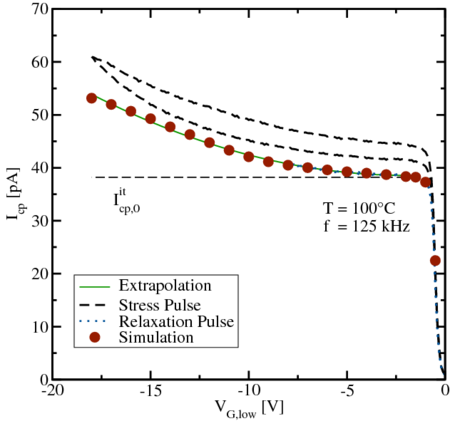
 and an
  field dependence. It
is stipulated that the simulation only describes oxide traps and interface
traps without applied stress conditions. Additional interface traps due to
NBTI stress are missing in the simulation because of a constant number of
interface traps for each simulation point (solid circles).
field dependence. It
is stipulated that the simulation only describes oxide traps and interface
traps without applied stress conditions. Additional interface traps due to
NBTI stress are missing in the simulation because of a constant number of
interface traps for each simulation point (solid circles).