The relentless demand for faster, smaller, and more energy-efficient digital storage and processing technologies continues to drive advances in spintronics. This field uses electron spin rather than its charge for information storage
and manipulation. This need has been further intensified by the rise of big data and artificial intelligence, which require rapid data writing, high-density storage, and reduced energy consumption [1]. In particular, the ability
to store information reliably and access it quickly while minimizing power usage has become critical for both embedded and large-scale computing systems.
Since the invention of the transistor [2, 3], several breakthroughs have shaped the evolution of computing and memory systems. Among these, the introduction of complementary metal oxide semiconductor (CMOS)
technology more than 50 years ago [4] enabled the transition from magnetic-core memories [5] to charge-based transistor memories like static and dynamic random access memory (RAM). Flash memory further
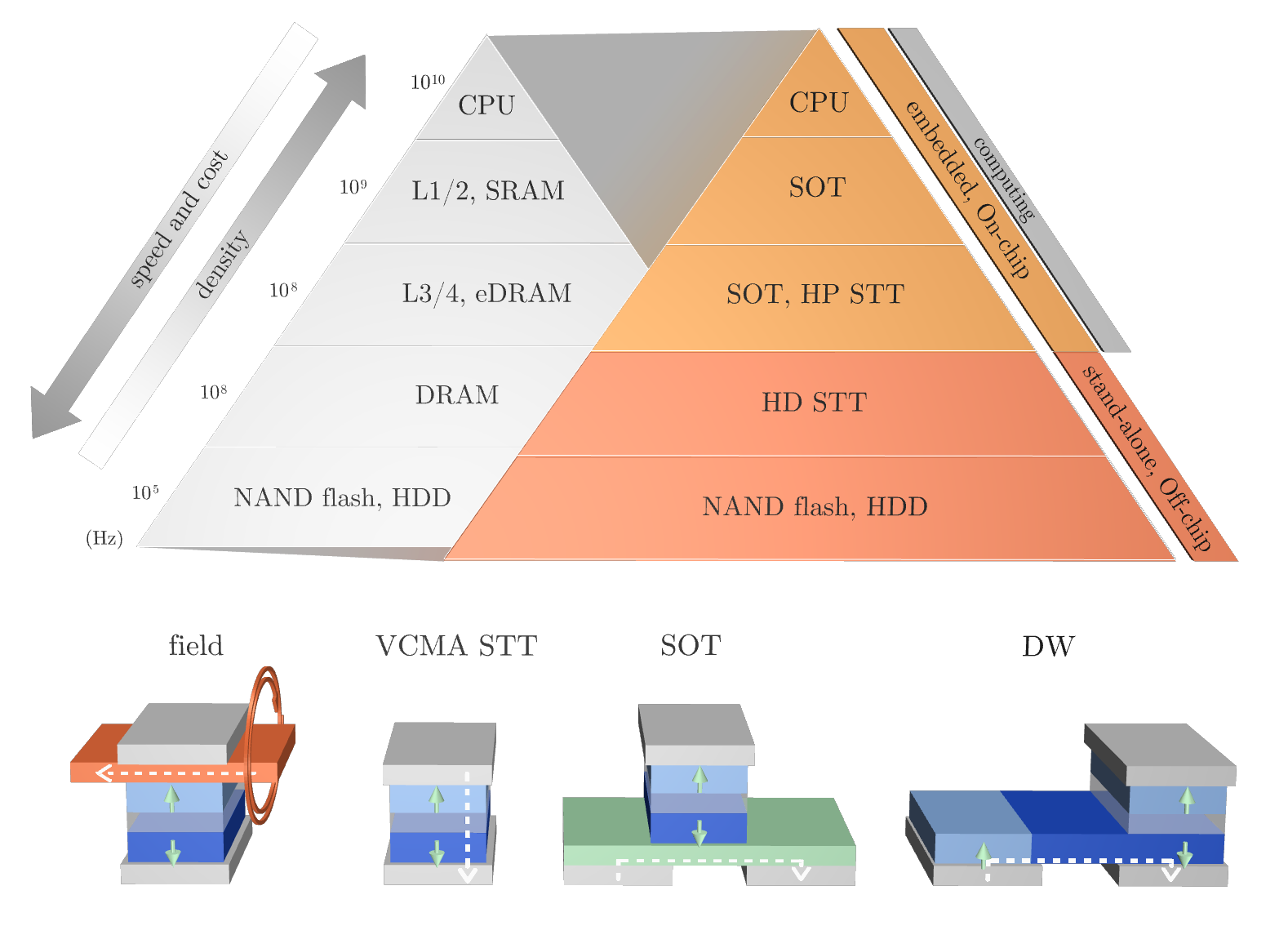
extended the capabilities of non-volatile storage. These developments led to the establishment of a hierarchical memory system, where each level is optimized for speed, power, cost, and location (see Figure 1.1).
However, the scaling of silicon CMOS is approaching its physical and economic limits [6, 7]. As energy efficiency becomes a key constraint, particularly for mobile, wearable, and edge computing devices, alternative
technologies are under active exploration. A crucial characteristic for energy saving is non-volatility: the ability to retain data even when power is off. This is especially important in devices that remain idle for extended periods, as
well as in high-performance systems such as supercomputers and data centers, where improving energy efficiency without compromising speed or endurance is essential.
Several types of non-volatile memory (NVM) technologies have been proposed, including variants of RAM such as resistive RAM (RRAM) [8], ferroelectric RAM (FeRAM) [9], phase-change RAM
(PCRAM) [10], and magnetoresistive random access memory (MRAM). Each offers a unique balance of speed, endurance, scalability, and energy efficiency, but also faces distinct challenges. Among these, MRAM has
emerged as a particularly promising candidate [11, 12, 13] due to its non-volatility, fast operation, and excellent endurance.
Figure 1.1: Schematics of different existing memory types (gray pyramid) and prospective spintronic technologies based on magnetic tunnel junctions (MTJs) that could replace them (colored pyramid). L1-L4 denote various
cache levels; static random access memory (SRAM) and dynamic random access memory (DRAM) represent static and dynamic random-access memory, respectively; and hard-disk drive (HDD) represents magnetic hard disk drives.
Mechanisms for writing bit information in MTJ devices include the Oersted field, spin-orbit torque magnetoresistive random access memory (SOT-MRAM), spin-transfer torque magnetoresistive random access memory (STT-MRAM),
and domain-wall (DW) motion.
Unlike conventional charge-based memories, MRAM exploits the quantum-mechanical degree of freedom associated with electron spin. The core storage element is the MTJ, which consists of a thin insulating barrier, typically
magnesium oxide (MgO), sandwiched between two ferromagnetic layers, such as cobalt iron boron (CoFeB). One layer has a fixed magnetization and serves as a reference, while the other (the free layer) can switch its magnetization
direction. Binary information is encoded in the relative alignment of these magnetizations: the parallel (P) configuration results in low resistance, and the anti-parallel (AP) configuration yields high resistance. This difference,
known as the tunneling magnetoresistance (TMR) effect [14, 15, 16, 17], enables simple, reliable electrical readout of the stored bit.
Early generations of MRAM relied on magnetic fields for data writing, in Stoner-Wohlfarth magnetoresistive random access memory (SW-MRAM), for instance, currents driven through orthogonal lines produced Oersted fields that
switched the magnetization of the free layer. While functional, this method faced limitations in scalability and write selectivity. Toggle MRAM enhanced stability and improved write margins, yet it remained dependent on external
fields, making large-scale integration into standard semiconductor processes challenging.
A major leap was the development of STT-MRAM [18, 19, 20]. In STT-MRAM, a spin-polarized current is passed directly through the MTJ, allowing the magnetization of the free layer to be switched
without external magnetic fields. This simplified the cell architecture and improved scalability. STT-MRAM also features fast switching and endurance on par with SRAM or DRAM [21]. However, its shared read/write
current paths lead to tunnel barrier wear and write disturbances, particularly at high operating frequencies. Despite this, refined device designs have demonstrated pulse switching as short as 0.3ns [22], highlighting its potential for ultra-fast operation.
MRAM is therefore positioned to function both as an embedded memory technology and as a candidate for universal memory. It offers a unique balance of speed, non-volatility, low power, and endurance, and can complement or
replace other memory types across various levels of the memory hierarchy. As illustrated in Figure 1.1, MTJ-based MRAM can be deployed from last-level cache to
system memory, bridging the gap between volatile and non-volatile storage in conventional architectures, and even enabling in-memory computing [23, 24].
The success of MRAM has been driven in part by material innovations. The CoFeB/MgO/CoFeB system, owing to its high TMR [25, 26] and interfacial perpendicular magnetic anisotropy
(PMA) [27, 28], has become a standard for MTJ design. It enables efficient switching, strong thermal stability, and excellent scalability, which are critical for both embedded and high-density applications.
Complementing experimental developments, the rapid progress in MRAM has been supported by advanced computational modeling. Simulation tools are essential for designing and optimizing devices with high efficiency and
reliability. The Landau–Lifshitz–Gilbert (LLG) equation, extended with spin-transfer torque terms, provides the theoretical foundation for modeling magnetization dynamics in MTJs. Standard numerical methods include the finite
difference method (FDM), known for parallelization efficiency, and the finite element method (FEM), which excels at handling complex geometries and material boundaries [29, 30].
As device dimensions shrink to the sub-20nm regime, the assumptions underlying simple macro-spin models break down [31]. Nonuniform
current distributions arise from the angle-dependent tunneling conductance of the MgO barrier, leading to spatially varying spin torques that spatially averaged treatments cannot capture. Composite free layers introduce additional
interfaces whose spin-filtering and spin-dephasing properties must be modeled explicitly [32]. Moreover, the increasing adoption of synthetic antiferromagnet (SAF) structures and interlayer exchange coupling (IEC)-mediated
multilayers [33, 34] demands numerical frameworks capable of resolving the coupling across ultrathin nonmagnetic spacers without resorting to prohibitively fine volumetric meshes. Addressing these challenges
requires a unified computational approach that couples three-dimensional micromagnetic solvers with self-consistent spin and charge transport models [35].
This thesis develops such a framework and applies it to investigate the switching dynamics, reliability phenomena, and design optimization of next-generation STT-MRAM devices. By combining a FEM-based micromagnetic solver
with a coupled drift-diffusion transport formalism, the work provides physical insights into ultra-scaled device behavior that are inaccessible to conventional macro-spin or one-dimensional analytical models.
1.1 Outline of the Thesis
This thesis focuses on the development and application of advanced computational techniques to analyze and optimize the behavior of modern STT-MRAM devices. Specifically, it addresses the modeling of various torque
contributions and their impact on magnetization switching dynamics, leveraging simulation frameworks built on C++ libraries. The thesis is organized as follows.
Chapter 2 provides a concise overview of the evolution, current architectures, and key operating principles of MRAM technologies, with particular emphasis on STT-MRAM cells.
The magnetoresistance phenomena underlying device readout, including giant magnetoresistance (GMR) and TMR, are reviewed, and the physical mechanisms governing thermal stability and spin-transfer torque switching are
discussed.
Chapter 3 introduces the micromagnetic modeling framework employed to simulate magnetization dynamics in spintronic devices. Central to this approach is the LLG equation,
whose derivation and physical interpretation are outlined in detail. The chapter discusses the primary contributions to the effective magnetic field, including exchange, anisotropy, demagnetization, IEC, and external fields. It
presents simplified expressions for spin-transfer torques (STTs) as they arise in both spin valve structures and MTJs.
Chapter 4 presents two numerical methods for spatially discretizing the computational domain in magnetization dynamics simulations: the FDM and the FEM. The chapter
begins by introducing the principles underlying both approaches and illustrates how the effective magnetic field components are discretized. Special emphasis is placed on the computation of current density redistribution in MTJs
with nonuniform magnetization, which significantly influences the spin-transfer torque. Furthermore, the in-house FDM-based solver is discussed in detail, including its implementation of the LLG equation.
Chapter 5 addresses the numerical time integration of the spatially discretized LLG equation. The key challenges of stiffness, the unit-sphere constraint, and geometric
structure preservation are identified. Three classes of time-stepping schemes are developed and compared: adaptive higher-order backward differentiation formula (BDF) methods, implicit-explicit (IMEX) schemes that treat the
exchange interaction implicitly, and a tangent-plane formulation that recasts the nonlinear constrained problem as a sequence of linear saddle-point systems. Verification is carried out using the \(\mu \)MAG Standard
Problem 4.
Chapter 6 extends the micromagnetic framework to include a coupled spin and charge drift-diffusion formalism for computing spin-transfer torques in ultra-scaled
MRAM cells. Specialized boundary conditions are derived to describe spin filtering at MgO tunnel barriers and spin dephasing at metallic interfaces. A novel numerical treatment of IEC is introduced via an interface-mapping
algorithm, enabling efficient simulation of SAF structures and composite free layers without volumetric meshing of angstrom-scale spacers.
Chapter 7 applies the complete simulation framework to investigate three interconnected phenomena in next-generation STT-MRAM devices. First, the switching
dynamics in ultra-scaled cells with composite free layers are analyzed, revealing the role of sequential switching and interface effects. Second, the back-hopping phenomenon is shown to be a deterministic consequence of composite
torque dynamics, and its deliberate exploitation for multi-level cell (MLC) operation is demonstrated. Third, advanced device architectures incorporating double spin-torque MTJs and SAF-enhanced reference layers are
systematically investigated, and quantitative design thresholds for reliable operation are identified.
Chapter 8 summarizes the principal contributions of this work, presents the main conclusions, and discusses directions for future research, including the
advancement of the numerical methods themselves toward higher-order finite elements, parallel-in-time integration, and fully coupled space-time formulations.