The preceding analysis established that inter-segment spin-transfer torques govern the sequential and cyclic switching dynamics in composite FL structures and can be harnessed for MLC operation, demonstrating that coupling
between magnetic layers is a resource rather than a liability. This section systematically introduces IEC as a design parameter by sweeping the coupling strength across different stack structures, establishing the distinct roles of IEC
in each configuration and motivating the advanced structures investigated in Section 7.6.
7.5.1 Interlayer Exchange Coupling as Control Parameter
The back-hopping analysis in Section 7.4 revealed that the inter-segment spin-transfer torque hierarchy governs the cyclic dynamics of composite FL structures. A
natural question is whether IEC, which adds an effective field coupling between magnetic layers, can modify or control these dynamics. This motivates a systematic investigation of IEC as a design parameter. The IEC adds an
effective field contribution to the LLG equation:
where \(J_{\text {iec}}\) is the coupling strength (positive for FM, negative for AFM alignment), \(t_{\text {FL}}\) is the FL thickness, and \(\mathbf {m}_{\text {adjacent}}\) is the magnetization of the adjacent layer,
as derived in Section 6.4 [202], this effective field can either assist or oppose the switching torques, depending on the sign and magnitude of the coupling.
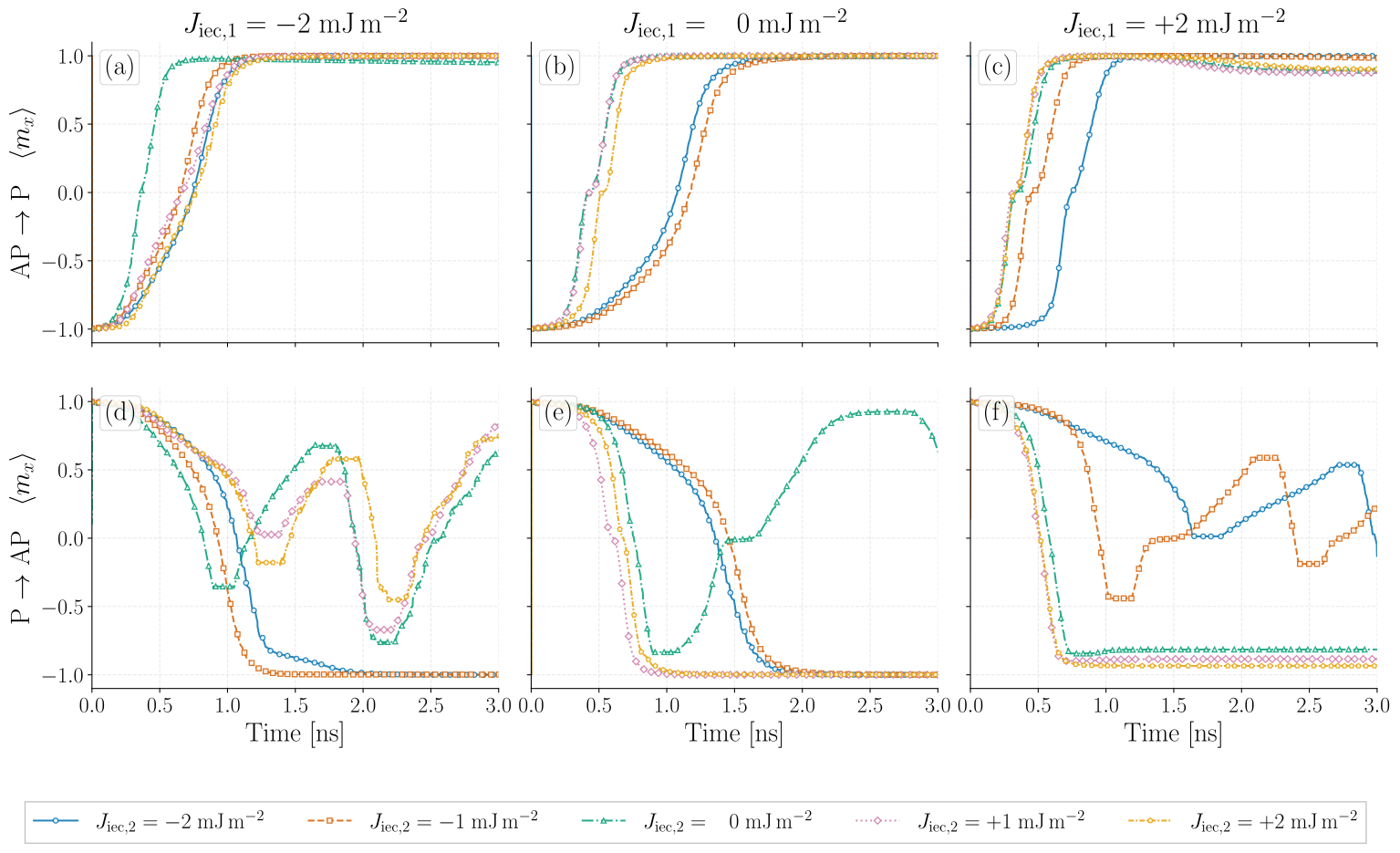
Figure 7.20: Influence of IEC strengths \(J_{\text {iec},1}\) and \(J_{\text {iec},2}\) on the AP\(\to \)P switching dynamics in the ultra-scaled composite FL with MgO TB separator (Figure 7.1 (d)).
The IEC is swept at the FL\(_1\)–FL\(_2\) interface through the middle MgO barrier: (a) negative \(J_{\text {iec},1}\) (AFM), (b) \(J_{\text {iec},1} = 0\), and (c) positive \(J_{\text {iec},1}\)
(FM), each producing distinct switching dynamics. Based on Figures [203].
The first sweep of \(J_{\text {iec},1}\) and \(J_{\text {iec},2}\) was conducted independently through negative (AFM), zero, and positive (FM) values for the composite FL with MgO TB separator (Figure 7.1 (d)). The \(\pm \SI {2}{\milli \joule \per \meter \squared }\) sweep covers experimentally reported coupling magnitudes for CoFeB\(|\)MgO
interfaces [204, 205] and metallic spacers [206, 207]. Both FM and AFM coupling have been observed, contingent upon spacer thickness and crystalline quality [195]. Figure 7.20 displays the AP\(\to \)P switching dynamics during this sweep. Specifically, AFM coupling at the FL\(_1\)–FL\(_2\) interface increases the energy barrier by opposing
ferromagnetic alignment, thereby delaying switching; this occurs because the torque must first overcome this added barrier. In contrast, zero coupling leads to the baseline sequential switching of Section 7.3, as there is neither assistance nor opposition. FM coupling facilitates switching by inducing cooperative alignment between FL\(_1\) and FL\(_2\); however, this
assistance can suppress the intermediate plateau, consequently eliminating the multi-level cell capability described in Section 7.4.
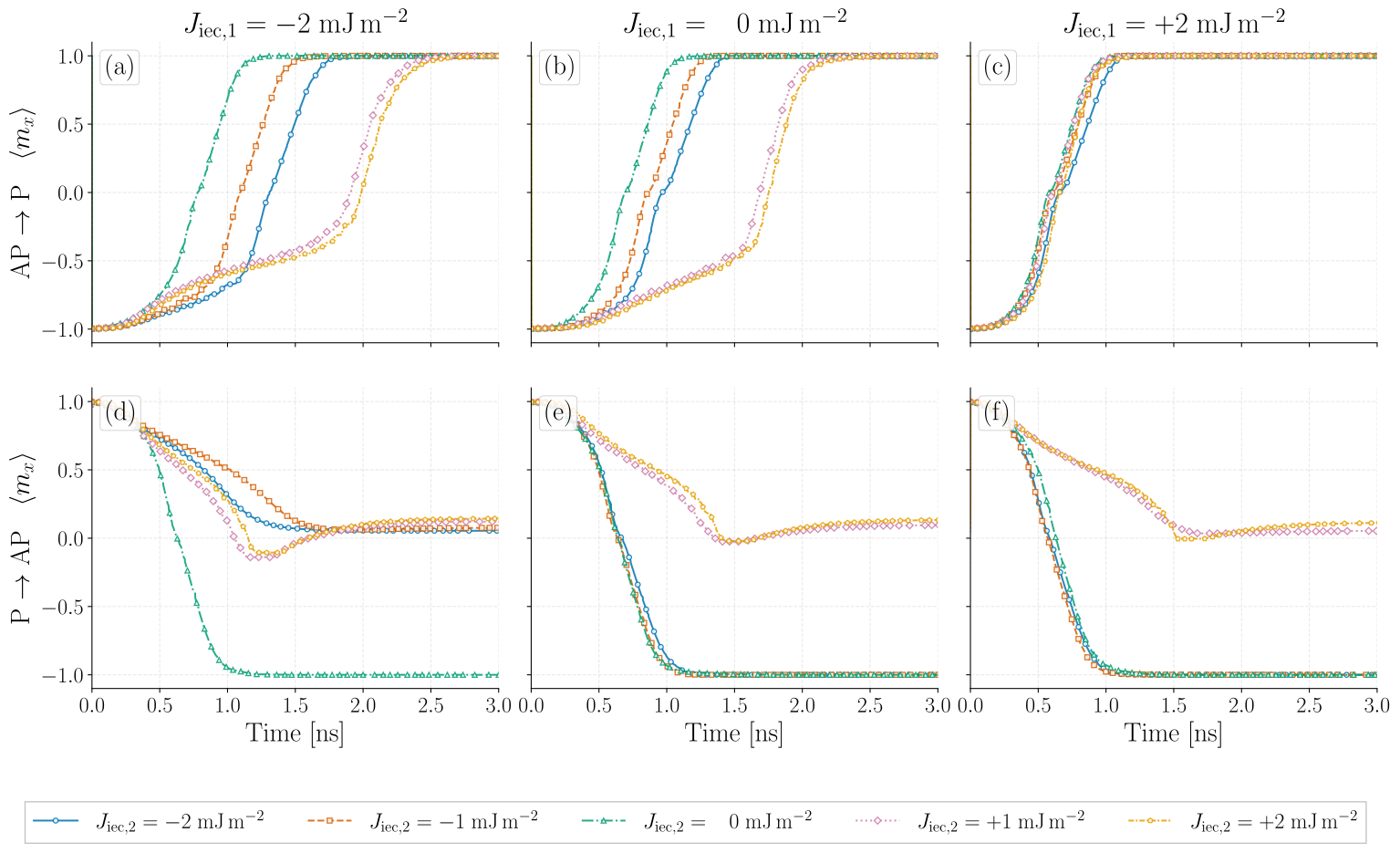
Next, the metallic NMS separator was analyzed (Figure 7.1 (e)). Both AP\(\to \)P and P\(\to \)AP transitions were included (Figure 7.21). The comparison shows a clear asymmetry between the two separator structures. The NMS variant transmits spin current more efficiently between the FL segments, making
switching dynamics more sensitive to \(J_{\text {iec}}\) variations.
Figure 7.21: Systematic IEC sweep for the two ultra-scaled composite FL structures from [208]: (a–c) AP\(\to \)P and (d–f) P\(\to \)AP transitions for the composite FL with MgO TB separator (Fig-
ure 7.1 (d)), and (g–l) the same analysis for the composite FL with NMS separator (Figure 7.1 (e)).
In each row, the left panel applies negative \(J_{\text {iec},1}\) (AFM), the middle panel sets \(J_{\text {iec},1} = 0\), and the right panel applies positive \(J_{\text {iec},1}\) (FM). The coupling strength range reflects
experimentally reported values for CoFeB\(|\)MgO interfaces [204, 205] and metallic spacers [206, 207]. Based on Figures [208].
Under AFM coupling, the NMS-separated structure exhibits stronger suppression of the second-segment reversal, while under FM coupling, it shows faster synchronized switching than the TB variant. The P\(\to \)AP direction is
consistently more sensitive to IEC than AP\(\to \)P, confirming the directional asymmetry established by the torque hierarchy analysis in Section 7.4.1. When
the bias is turned off at 2.5ns, the system relaxes to the desired final state in the AP\(\to \)P direction. In contrast, certain P\(\to \)AP
configurations settle into an intermediate anti-parallel FL\(_1\)–FL\(_2\) arrangement rather than a complete AP state, confirming that properly tuned AFM IEC can stabilize the final magnetic state and suppress
back-transitions. An alternative mitigation strategy is to engineer structural asymmetry in the MTJ stack: Manchon et al. [209] showed that breaking inversion symmetry modifies the bias dependence of
the spin torque, and Oh et al. [210] demonstrated experimentally that asymmetries in material composition expand the stability region of the parallel configuration and suppress back-hopping.
These initial sweeps on ultra-scaled structures established IEC as a tunable design parameter. The follow-up study [116] extended this investigation to three distinct stack families spanning different IEC roles, from
back-hopping suppression to reliability threshold control, as detailed in the following subsection.
7.5.2 Systematic IEC Sweep Across Three Stack Configurations
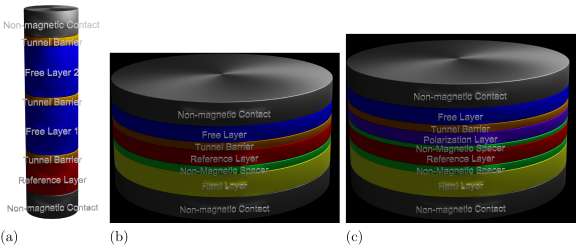
Figure 7.22: Layer stacks of the three configurations studied in [116]: (a) Stack A (ultra-scaled composite FL, same architecture as Figure 7.1 (d)),
(b) Stack B (SAF without polarization layer (PL)), and (c) Stack C (SAF with PL). IEC acts at different interfaces in each stack: FL\(_1\)–FL\(_2\) coupling through TB\(_2\) in Stack A, HL–RL
coupling through Ru in Stack B, and both HL–RL (AFM) and RL–PL (FM) coupling in Stack C.
Stack A (ultra-scaled composite FL, diameter 2.3nm Figure 7.22 (a)) features IEC between FL\(_1\) and FL\(_2\) through an MgO TB. A weak FM coupling of \(J_{\text {iec}} \approx \SI {0.01}{\milli \joule
\per \meter \squared }\) [116, 205], consistent with the weak FM coupling observed experimentally in
CoFeB\(|\)MgO\(|\)CoFeB structures [211], is sufficient to suppress back-hopping while preserving fast switching: the FM coupling prevents the field-like torque from reversing the FL\(_2\) magnetization, while the
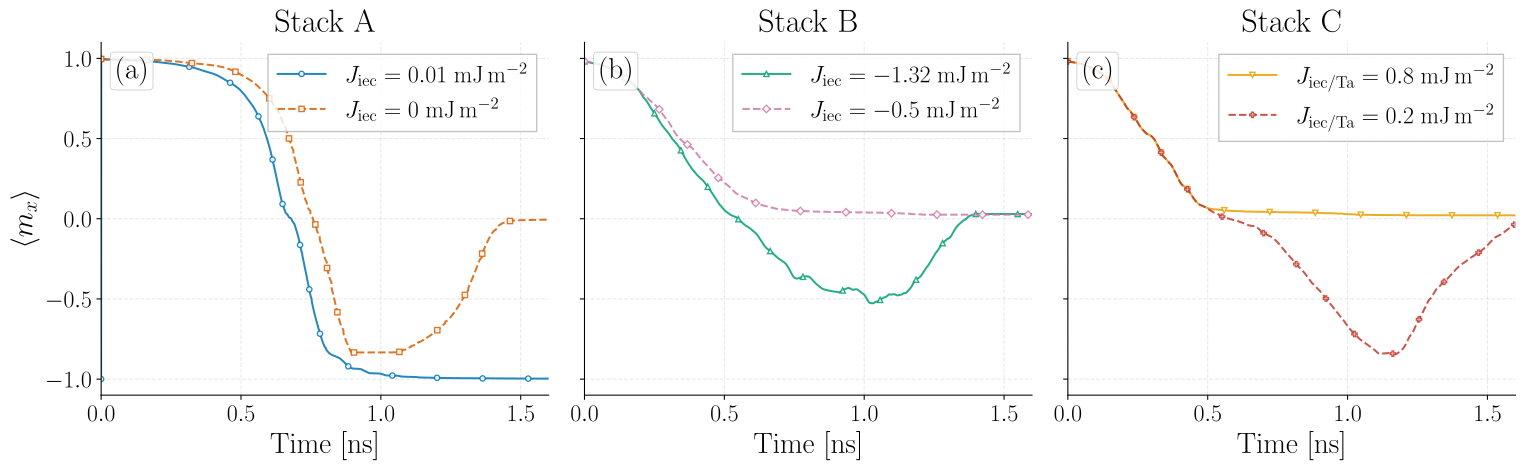
coupled FL\(_1\)–FL\(_2\) system initiates reversal more uniformly. Figure 7.23(a) illustrates this contrast: with \(J_{\text {iec}} = \SI {0.01}{\milli
\joule \per \meter \squared }\), the averaged FL magnetization \(\langle m_x \rangle \) switches cleanly from \(+1\) to \(-1\) within \({\sim }\SI {1}{\nano \second }\), whereas the uncoupled case (\(J_{\text
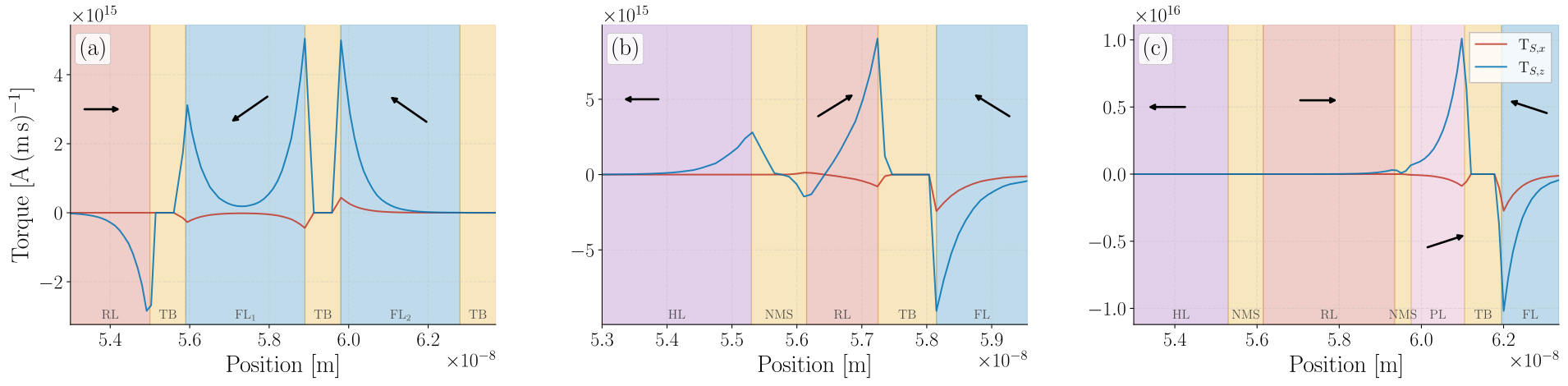
{iec}} = 0\)) exhibits back-hopping with the magnetization reverting toward \(\langle m_x \rangle \approx +0.2\). The torque distribution at the onset of back-hopping (Figure 7.24(a)) reveals that the damping-like component \(T_{S,z}\) peaks at each MgO interface, with the torque contributions from FL\(_1\) driving the reversal of FL\(_2\) by
overcoming the interface anisotropy. Note that \(J_{\text {iec}}\) is highly sensitive to the MgO barrier thickness and the quality of the CoFeB\(|\)MgO interfaces. Consequently, maintaining this specific coupling is
experimentally demanding, and subtle deviations in the fabrication process, particularly regarding interface morphology and barrier thickness, can result in an insufficient coupling strength, thereby reintroducing back-hopping
failures during operation.
Stack B (SAF without PL, diameter 70nm, Figure 7.22 (b)), a diameter widely used in experimental characterization and demonstration of perpendicular MTJs [185], employs AFM coupling between the CoPt
hard layer (HL) and the CoFeB RL through a Ru NMS [212]. At the nominal coupling strength of \(J_{\text {iec}} = \SI {-1.32}{\milli \joule \per \meter \squared }\) [207], the strong AFM coupling
prevents RL reversal, maintaining stable AP alignment between HL and RL. At a reduced coupling of \(\SI {-0.5}{\milli \joule \per \meter \squared }\), however, the torques from the FL overcome the IEC, allowing
domain wall formation in both FL and RL and triggering back-and-forth switching. Figure 7.23(b) captures this behavior: the strong-coupling curve reaches
\(\langle m_x \rangle = 0\), confirming stable AP alignment between RL and FL, while the weak-coupling curve oscillates as domain walls form in both the FL and the RL. The torque distribution (Figure 7.24(b)) shows that the HL generates a large damping-like torque \(T_{S,z}\) at the Ru interface that opposes RL reversal. In contrast, the FL exerts a competing torque through
the MgO TB that drives the RL toward P alignment. When the AFM coupling is sufficiently strong, the IEC effective field reinforces the HL torque and stabilizes the RL.
Figure 7.23: Switching trajectories during P\(\to \)AP transition for the three stack configurations: (a) Stack A (ultra-scaled composite FL), (b) Stack B (SAF without PL), and (c) Stack C
(SAF with PL). Weak FM coupling suppresses back-hopping in Stack A, strong AFM coupling maintains RL stability in Stack B, and PL reversal in Stack C depends on the RL–PL coupling strength [116].
Figure 7.24: Spin-torque distribution at the moment of back-hopping onset for (a) Stack A, (b) Stack B, and (c) Stack C. The field-like component \(T_{S,x}\) and damping-like component
\(T_{S,z}\) reveal distinct torque patterns at each ferromagnetic interface, with IEC modifying both the magnitude and spatial distribution of the torques [116].
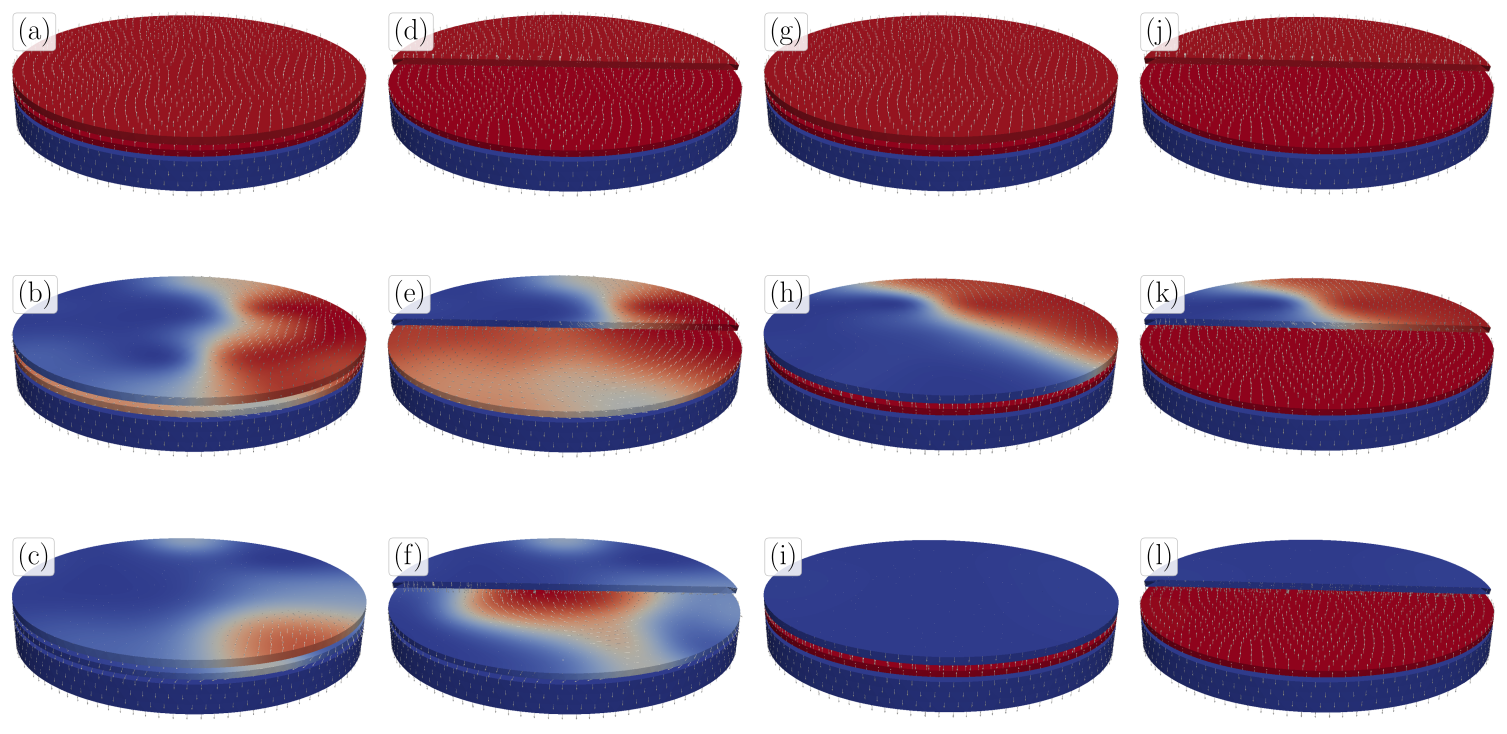
The three-dimensional magnetization snapshots in Figure 7.25 visualize this contrast: under weak coupling ((a)–(f)), domain walls nucleate in the RL by \({\sim }\SI
{0.4}{\nano \second }\) and its magnetization reverses almost completely by \({\sim }\SI {1}{\nano \second }\), whereas under strong coupling ((g)–(l)) the RL remains uniformly magnetized throughout the switching
process.
Stack C (SAF with PL, diameter 70nm, Figure 7.22 (c)) adds a CoFeB PL coupled to the RL through a Ta NMS, with AFM coupling between HL and RL through Ru (\(J_{\text {iec}} = \SI
{-1.5}{\milli \joule \per \meter \squared }\) [207]). The FM coupling between RL and PL controls PL stability: at the originally proposed coupling of \(\SI {0.8}{\milli \joule \per \meter \squared
}\) [213], back-hopping is absent, whereas a revised weaker estimate of \(\SI {0.21}{\milli \joule \per \meter \squared }\) [195, 214] allows the torques from the FL to overcome the IEC and reverse
the PL magnetization. As shown in Figure 7.23(c), the strong-coupling case produces a clean transition to \(\langle m_x \rangle \approx 0\), confirming that
only the FL switches while the PL remains fixed. Under weak coupling, the trajectory overshoots to \(\langle m_x \rangle \approx -0.5\) as the PL reverses before partially recovering. The torque analysis (Figure 7.24(c)) reveals that the FL, near complete reversal, exerts a parasitic torque on the PL through the Ta NMS. The coupling strength determines whether the IEC effective field can
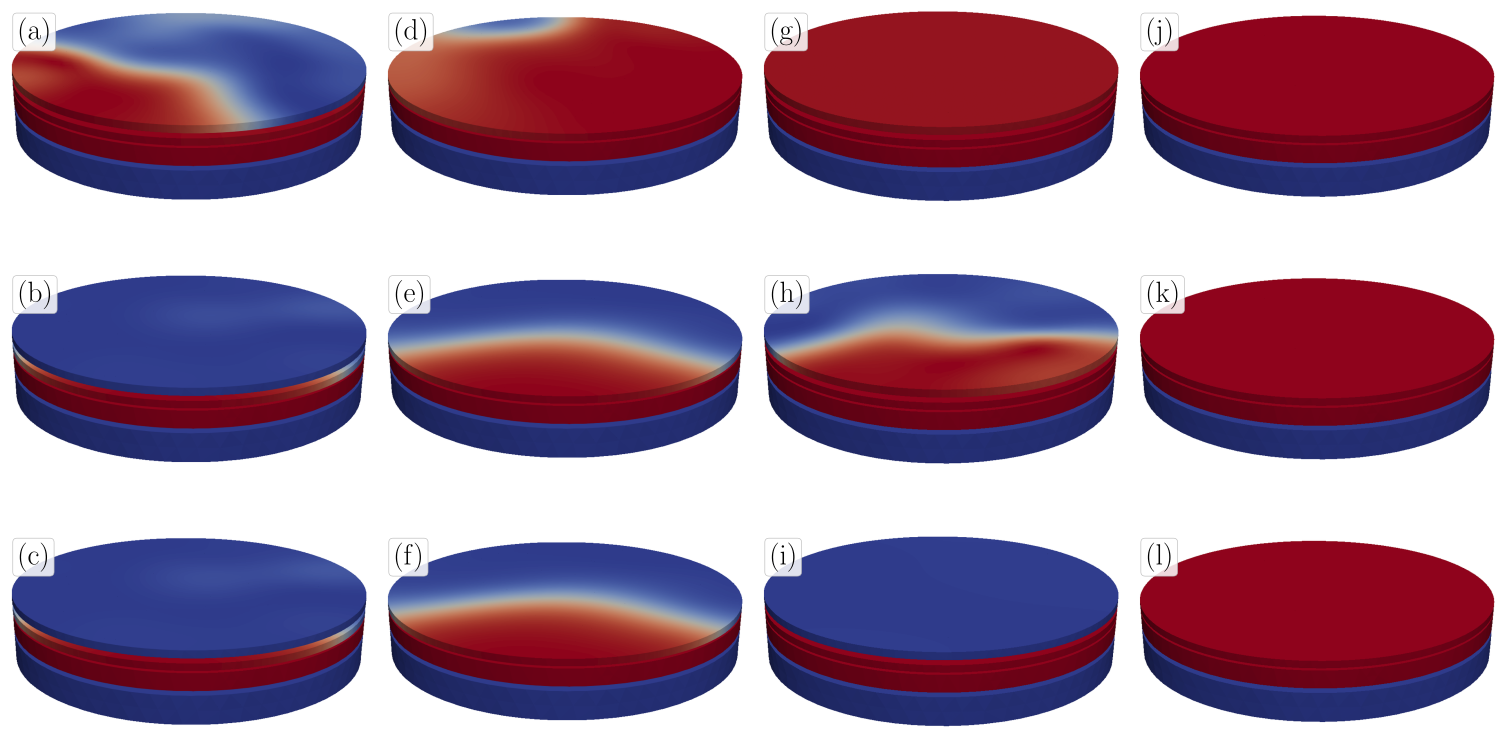
counteract this torque. Figure 7.26 provides three-dimensional confirmation: under weak coupling ((a)–(f)), the PL magnetization gradually reverses from its initial
orientation to nearly complete inversion by \({\sim }\SI {1}{\nano \second }\), while under strong coupling ((g)–(l)) the PL retains its original orientation throughout.
Figure 7.25: Three-dimensional magnetization states during P\(\to \)AP switching in Stack B (SAF without PL), contrasting weak (\(J_{\text {iec}} = \SI {-0.5}{\milli \joule \per \meter \squared }\))
and strong (\(J_{\text {iec}} = \SI {-1.32}{\milli \joule \per \meter \squared }\)) AFM HL–RL coupling. (a)–(c) weak coupling, full view and (d)–(f) weak coupling, FL clipped to reveal RL, (g)–
(i) strong coupling, full view and (j)–(l) strong coupling, FL clipped to reveal RL. Columns show the initial state, mid-switching (\({\sim }\SI {0.4}{\nano \second }\)), and final state (\({\sim }\SI {1}{\nano
\second }\)). With strong coupling, the RL remains uniformly oriented throughout switching, with weak coupling, the RL develops domain walls and its magnetization reverses almost completely [215].
Figure 7.26: Three-dimensional magnetization states during P\(\to \)AP switching in Stack C (SAF with PL), contrasting weak (\(J_{\text {iec}} = \SI {0.2}{\milli \joule \per \meter \squared }\)) and
strong (\(J_{\text {iec}} = \SI {0.8}{\milli \joule \per \meter \squared }\)) FM RL–PL coupling. (a)–(c) weak coupling, full view and (d)–(f) weak coupling, FL clipped to reveal PL, (g)–(i) strong
coupling, full view and (j)–(l) strong coupling, FL clipped to reveal PL. Columns show the initial state, mid-switching (\({\sim }\SI {0.4}{\nano \second }\)), and final state (\({\sim }\SI {1}{\nano \second }\)).
With strong coupling, the PL remains stable, with weak coupling, the PL reverses almost completely due to parasitic spin-torques overcoming the IEC [215].
The three-stack comparison demonstrates that IEC plays distinct roles depending on architecture: modifier of sequential switching dynamics (Stack A), RL stability guarantee (Stack B), and PL alignment control
(Stack C). These roles motivate the dedicated investigations of hybrid FL structures and ds-MTJ speed enhancement in the following section.
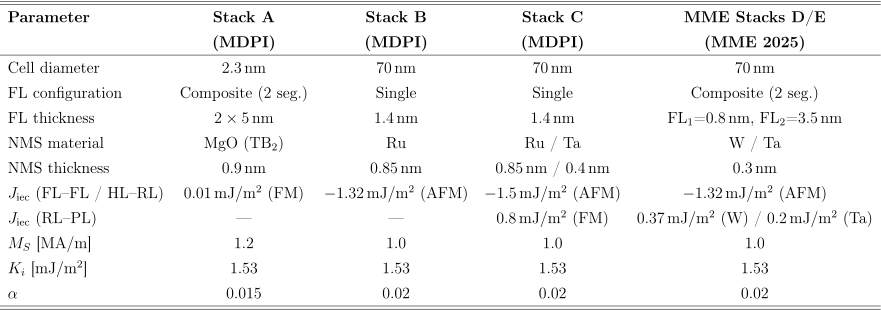
Table 7.4: Material and geometry parameters for the three MDPI 2024 stack configurations [116] and the MME 2025 SAF-enhanced stacks [216].
Common parameters are listed in Table 7.1.