The comprehensive simulation studies presented in this chapter yield a consistent picture: IEC emerges as the central design parameter across all device families studied, with its role evolving systematically from a modifier to an
engineering parameter. This section synthesizes the key findings into practical design rules and summarizes the main conclusions.
7.7.1 Design Guidelines for Ultra-Scaled Composite FL Structures
For 2.3nm diameter devices with CoFeB\(|\)MgO materials, the optimal FL segment length is 3nm to 5nm: shorter segments (2nm to 3nm) exhibit back-hopping instability during P\(\to
\)AP switching due to insufficient anisotropy barriers. In comparison, longer segments (above 6nm to 7nm) fail to complete switching at moderate bias (\(\leq \)2V)
from stray field stabilization of intermediate states. Interface-localized anisotropy models should be used for elongated structures, where they predict 10–15% faster P\(\to \)AP switching compared to bulk averaging
(transition region \(\tau = \SIrange {0.5}{1.0}{\nano \meter }\)). The middle TB polarization determines the switching regime: keeping TB\(_2\) below TB\(_1\) ensures binary operation, whereas enhancing TB\(_2\)
above TB\(_1\) enables controlled back-hopping with four accessible MLC states.
7.7.2 Design Guidelines for Multi-Level Cell Implementation
Symmetric FL segments (both 3nm to 4nm) maximize
resistance separation between intermediate states. Reliable state addressing requires write pulse duration control with approximately 100ps
resolution, a minimum 20% resistance margin between adjacent states through TB thickness optimization, and verified thermal stability (\(\Delta > 40\)) for all four configurations, particularly the intermediate
anti-parallel FL\(_1\)/FL\(_2\) states.
7.7.3 Design Guidelines for ds-MTJ
and SAF-Enhanced Structures
For NMS material selection, Ru provides 2–3\(\times \) switching speed enhancement via its longer spin-flip length (4nm), while Ta offers
1.2–1.5\(\times \) enhancement with better process compatibility. SAF coupling strength must maintain \(|J_{\text {iec}}| > \SI {1.0}{\milli \joule \per \meter \squared }\) (AFM) at the HL–RL interface and
\(|J_{\text {iec}}| > \SI {0.5}{\milli \joule \per \meter \squared }\) (FM) at the RL–PL interface, with margins for \(\pm \)30% process variation and temperature dependence. NMS thickness should
target the first AFM coupling peak for Ru (approximately 0.8nm to 0.9nm). For Ta, select a thickness that provides the desired FM coupling while maintaining adequate spin transport, and verify the coupling sign and magnitude experimentally.
7.7.4 Cross-Architecture Performance Comparison
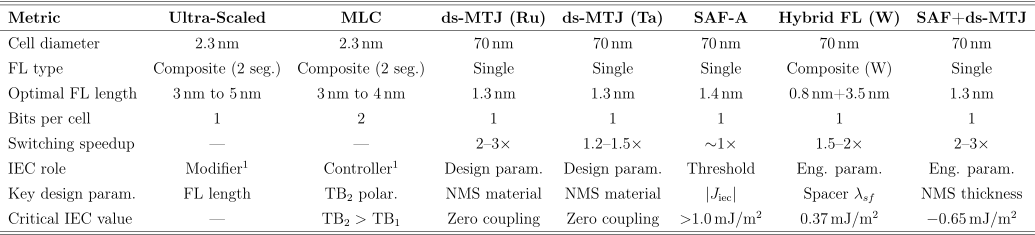
Table 7.7 consolidates the quantitative performance of all seven device configurations. As device complexity increases from single FL composites to SAF-enhanced
and hybrid structures, the role of IEC escalates from an incidental modifier to an engineering parameter jointly optimized across multiple interfaces. The final two columns, derived from Section 7.6, represent the culmination of this progression: spacer material, thickness, and coupling strength are jointly tuned for switching speed, write efficiency, and reference layer stability.
IEC as unifying design parameter.
Across all structures studied in this chapter, inter-layer coupling emerges as the single physical theme whose role evolves most dramatically with device complexity. In ultra-scaled composite FLs, inter-segment spin-transfer torques
through TB\(_2\) drive the sequential switching of individual ferromagnetic segments without any IEC (\(J_{\text {iec}} = 0\), Section 7.3). In
composite structures operating in the back-hopping regime, these same spin-transport torques govern the cyclic dynamics that generate windmill states, enabling multilevel storage (Section 7.4). In ds-MTJ structures with dual reference layers, IEC becomes a tunable design parameter that governs the switching speed enhancement achievable through constructive
torque cooperation (Section 7.5). Finally, in SAF-enhanced structures, IEC strength exceeding 1mJ/m2 is required as a quantitative threshold for reference layer stability, without which the device fails catastrophically during write operations (Section 7.6.1). In advanced structures combining hybrid FLs with SAF-stabilized double spin-torque reference layers (Section 7.6), IEC transitions from a constraint to be satisfied to an engineering parameter to be optimized, with the NMS material’s spin-flip length and thickness jointly determining
switching speed, write efficiency, and reference layer stability. This progression from modifier to controller to design parameter to reliability threshold to engineering parameter constitutes the chapter’s central physical narrative. It
also provides a systematic framework for future STT-MRAM development. As device structures grow in complexity, IEC management transitions from a secondary consideration to a primary design axis alongside thermal stability
and switching speed.
Table 7.7: Cross-architecture comparison of the seven device configurations studied in this chapter. Each column represents a distinct architecture family, and rows compare key design metrics and the role of IEC. Switching
speedup is relative to a conventional single-RL pMTJ. Dashes indicate metrics not applicable or not directly quantified for that architecture. The ultra-scaled and MLC studies (Sections 7.3
and 7.4) use \(J_{\text {iec}} = 0\), the IEC role listed refers to the effect observed when coupling is subsequently introduced (Section 7.5).
1Role observed when IEC is introduced in Section 7.5. Base studies use \(J_{\text {iec}} = 0\).