[ Previous ] [ Home ] [ Next ]

Numerical Analysis and Innovative Simulation
Techniques for Designing Advanced MRAM

\(\newcommand{\footnotename}{footnote}\) \(\def \LWRfootnote {1}\) \(\newcommand {\footnote }[2][\LWRfootnote ]{{}^{\mathrm {#1}}}\) \(\newcommand {\footnotemark }[1][\LWRfootnote ]{{}^{\mathrm {#1}}}\) \(\let \LWRorighspace \hspace \) \(\renewcommand {\hspace }{\ifstar \LWRorighspace \LWRorighspace }\) \(\newcommand {\TextOrMath }[2]{#2}\) \(\newcommand {\mathnormal }[1]{{#1}}\) \(\newcommand \ensuremath [1]{#1}\) \(\newcommand {\LWRframebox }[2][]{\fbox {#2}} \newcommand {\framebox }[1][]{\LWRframebox } \) \(\newcommand {\setlength }[2]{}\) \(\newcommand {\addtolength }[2]{}\) \(\newcommand {\setcounter }[2]{}\) \(\newcommand {\addtocounter }[2]{}\) \(\newcommand {\arabic }[1]{}\) \(\newcommand {\number }[1]{}\) \(\newcommand {\noalign }[1]{\text {#1}\notag \\}\) \(\newcommand {\cline }[1]{}\) \(\newcommand {\directlua }[1]{\text {(directlua)}}\) \(\newcommand {\luatexdirectlua }[1]{\text {(directlua)}}\) \(\newcommand {\protect }{}\) \(\def \LWRabsorbnumber #1 {}\) \(\def \LWRabsorbquotenumber "#1 {}\) \(\newcommand {\LWRabsorboption }[1][]{}\) \(\newcommand {\LWRabsorbtwooptions }[1][]{\LWRabsorboption }\) \(\def \mathchar {\ifnextchar "\LWRabsorbquotenumber \LWRabsorbnumber }\) \(\def \mathcode #1={\mathchar }\) \(\let \delcode \mathcode \) \(\let \delimiter \mathchar \) \(\def \oe {\unicode {x0153}}\) \(\def \OE {\unicode {x0152}}\) \(\def \ae {\unicode {x00E6}}\) \(\def \AE {\unicode {x00C6}}\) \(\def \aa {\unicode {x00E5}}\) \(\def \AA {\unicode {x00C5}}\) \(\def \o {\unicode {x00F8}}\) \(\def \O {\unicode {x00D8}}\) \(\def \l {\unicode {x0142}}\) \(\def \L {\unicode {x0141}}\) \(\def \ss {\unicode {x00DF}}\) \(\def \SS {\unicode {x1E9E}}\) \(\def \dag {\unicode {x2020}}\) \(\def \ddag {\unicode {x2021}}\) \(\def \P {\unicode {x00B6}}\) \(\def \copyright {\unicode {x00A9}}\) \(\def \pounds {\unicode {x00A3}}\) \(\let \LWRref \ref \) \(\renewcommand {\ref }{\ifstar \LWRref \LWRref }\) \( \newcommand {\multicolumn }[3]{#3}\) \(\require {textcomp}\) \(\newcommand {\mathlarger }[1]{#1}\) \(\newcommand {\mathsmaller }[1]{#1}\) \(\newcommand {\intertext }[1]{\text {#1}\notag \\}\) \(\let \Hat \hat \) \(\let \Check \check \) \(\let \Tilde \tilde \) \(\let \Acute \acute \) \(\let \Grave \grave \) \(\let \Dot \dot \) \(\let \Ddot \ddot \) \(\let \Breve \breve \) \(\let \Bar \bar \) \(\let \Vec \vec \) \(\newcommand {\toprule }[1][]{\hline }\) \(\let \midrule \toprule \) \(\let \bottomrule \toprule \) \(\def \LWRbooktabscmidruleparen (#1)#2{}\) \(\newcommand {\LWRbooktabscmidrulenoparen }[1]{}\) \(\newcommand {\cmidrule }[1][]{\ifnextchar (\LWRbooktabscmidruleparen \LWRbooktabscmidrulenoparen }\) \(\newcommand {\morecmidrules }{}\) \(\newcommand {\specialrule }[3]{\hline }\) \(\newcommand {\addlinespace }[1][]{}\) \(\newcommand {\bm }[1]{\boldsymbol {#1}}\) \(\newcommand {\LWRsubmultirow }[2][]{#2}\) \(\newcommand {\LWRmultirow }[2][]{\LWRsubmultirow }\) \(\newcommand {\multirow }[2][]{\LWRmultirow }\) \(\newcommand {\mrowcell }{}\) \(\newcommand {\mcolrowcell }{}\) \(\newcommand {\STneed }[1]{}\) \(\newcommand {\tothe }[1]{^{#1}}\) \(\newcommand {\raiseto }[2]{{#2}^{#1}}\) \(\newcommand {\LWRsiunitxEND }{}\) \(\def \LWRsiunitxang #1;#2;#3;#4\LWRsiunitxEND {\ifblank {#1}{}{\num {#1}\degree }\ifblank {#2}{}{\num {#2}^{\unicode {x2032}}}\ifblank {#3}{}{\num {#3}^{\unicode {x2033}}}}\) \(\newcommand {\ang }[2][]{\LWRsiunitxang #2;;;\LWRsiunitxEND }\) \(\def \LWRsiunitxdistribunit {}\) \(\newcommand {\LWRsiunitxENDTWO }{}\) \(\def \LWRsiunitxprintdecimalsubtwo #1,#2,#3\LWRsiunitxENDTWO {\ifblank {#1}{0}{\mathrm {#1}}\ifblank {#2}{}{{\LWRsiunitxdecimal }\mathrm {#2}}}\) \(\def \LWRsiunitxprintdecimalsub #1.#2.#3\LWRsiunitxEND {\LWRsiunitxprintdecimalsubtwo #1,,\LWRsiunitxENDTWO \ifblank {#2}{}{{\LWRsiunitxdecimal }\LWRsiunitxprintdecimalsubtwo #2,,\LWRsiunitxENDTWO }}\) \(\newcommand {\LWRsiunitxprintdecimal }[1]{\LWRsiunitxprintdecimalsub #1...\LWRsiunitxEND }\) \(\def \LWRsiunitxnumplus #1+#2+#3\LWRsiunitxEND {\ifblank {#2}{\LWRsiunitxprintdecimal {#1}}{\ifblank {#1}{\LWRsiunitxprintdecimal {#2}}{\LWRsiunitxprintdecimal {#1}\unicode {x02B}\LWRsiunitxprintdecimal {#2}}}\LWRsiunitxdistribunit }\) \(\def \LWRsiunitxnumminus #1-#2-#3\LWRsiunitxEND {\ifblank {#2}{\LWRsiunitxnumplus #1+++\LWRsiunitxEND }{\ifblank {#1}{}{\LWRsiunitxprintdecimal {#1}}\unicode {x02212}\LWRsiunitxprintdecimal {#2}\LWRsiunitxdistribunit }}\) \(\def \LWRsiunitxnumpmmacro #1\pm #2\pm #3\LWRsiunitxEND {\ifblank {#2}{\LWRsiunitxnumminus #1---\LWRsiunitxEND }{\LWRsiunitxprintdecimal {#1}\unicode {x0B1}\LWRsiunitxprintdecimal {#2}\LWRsiunitxdistribunit }}\) \(\def \LWRsiunitxnumpm #1+-#2+-#3\LWRsiunitxEND {\ifblank {#2}{\LWRsiunitxnumpmmacro #1\pm \pm \pm \LWRsiunitxEND }{\LWRsiunitxprintdecimal {#1}\unicode {x0B1}\LWRsiunitxprintdecimal {#2}\LWRsiunitxdistribunit }}\) \(\newcommand {\LWRsiunitxnumscientific }[2]{\ifblank {#1}{}{\ifstrequal {#1}{-}{-}{\LWRsiunitxprintdecimal {#1}\times }}10^{\LWRsiunitxprintdecimal {#2}}\LWRsiunitxdistribunit }\) \(\def \LWRsiunitxnumD #1D#2D#3\LWRsiunitxEND {\ifblank {#2}{\LWRsiunitxnumpm #1+-+-\LWRsiunitxEND }{\mathrm {\LWRsiunitxnumscientific {#1}{#2}}}}\) \(\def \LWRsiunitxnumd #1d#2d#3\LWRsiunitxEND {\ifblank {#2}{\LWRsiunitxnumD #1DDD\LWRsiunitxEND }{\mathrm {\LWRsiunitxnumscientific {#1}{#2}}}}\) \(\def \LWRsiunitxnumE #1E#2E#3\LWRsiunitxEND {\ifblank {#2}{\LWRsiunitxnumd #1ddd\LWRsiunitxEND }{\mathrm {\LWRsiunitxnumscientific {#1}{#2}}}}\) \(\def \LWRsiunitxnume #1e#2e#3\LWRsiunitxEND {\ifblank {#2}{\LWRsiunitxnumE #1EEE\LWRsiunitxEND }{\mathrm {\LWRsiunitxnumscientific {#1}{#2}}}}\) \(\def \LWRsiunitxnumx #1x#2x#3x#4\LWRsiunitxEND {\ifblank {#2}{\LWRsiunitxnume #1eee\LWRsiunitxEND }{\ifblank {#3}{\LWRsiunitxnume #1eee\LWRsiunitxEND \times \LWRsiunitxnume #2eee\LWRsiunitxEND }{\LWRsiunitxnume #1eee\LWRsiunitxEND \times \LWRsiunitxnume #2eee\LWRsiunitxEND \times \LWRsiunitxnume #3eee\LWRsiunitxEND }}}\) \(\newcommand {\num }[2][]{\LWRsiunitxnumx #2xxxxx\LWRsiunitxEND }\) \(\newcommand {\si }[2][]{\mathrm {\gsubstitute {#2}{~}{\,}}}\) \(\def \LWRsiunitxSIopt #1[#2]#3{\def \LWRsiunitxdistribunit {\,\si {#3}}{#2}\num {#1}\def \LWRsiunitxdistribunit {}}\) \(\newcommand {\LWRsiunitxSI }[2]{\def \LWRsiunitxdistribunit {\,\si {#2}}\num {#1}\def \LWRsiunitxdistribunit {}}\) \(\newcommand {\SI }[2][]{\ifnextchar [{\LWRsiunitxSIopt {#2}}{\LWRsiunitxSI {#2}}}\) \(\newcommand {\numlist }[2][]{\text {#2}}\) \(\newcommand {\numrange }[3][]{\num {#2}\ \LWRsiunitxrangephrase \ \num {#3}}\) \(\newcommand {\SIlist }[3][]{\text {#2}\,\si {#3}}\) \(\newcommand {\SIrange }[4][]{\num {#2}\,#4\ \LWRsiunitxrangephrase \ \num {#3}\,#4}\) \(\newcommand {\tablenum }[2][]{\mathrm {#2}}\) \(\newcommand {\ampere }{\mathrm {A}}\) \(\newcommand {\candela }{\mathrm {cd}}\) \(\newcommand {\kelvin }{\mathrm {K}}\) \(\newcommand {\kilogram }{\mathrm {kg}}\) \(\newcommand {\metre }{\mathrm {m}}\) \(\newcommand {\mole }{\mathrm {mol}}\) \(\newcommand {\second }{\mathrm {s}}\) \(\newcommand {\becquerel }{\mathrm {Bq}}\) \(\newcommand {\degreeCelsius }{\unicode {x2103}}\) \(\newcommand {\coulomb }{\mathrm {C}}\) \(\newcommand {\farad }{\mathrm {F}}\) \(\newcommand {\gray }{\mathrm {Gy}}\) \(\newcommand {\hertz }{\mathrm {Hz}}\) \(\newcommand {\henry }{\mathrm {H}}\) \(\newcommand {\joule }{\mathrm {J}}\) \(\newcommand {\katal }{\mathrm {kat}}\) \(\newcommand {\lumen }{\mathrm {lm}}\) \(\newcommand {\lux }{\mathrm {lx}}\) \(\newcommand {\newton }{\mathrm {N}}\) \(\newcommand {\ohm }{\mathrm {\Omega }}\) \(\newcommand {\pascal }{\mathrm {Pa}}\) \(\newcommand {\radian }{\mathrm {rad}}\) \(\newcommand {\siemens }{\mathrm {S}}\) \(\newcommand {\sievert }{\mathrm {Sv}}\) \(\newcommand {\steradian }{\mathrm {sr}}\) \(\newcommand {\tesla }{\mathrm {T}}\) \(\newcommand {\volt }{\mathrm {V}}\) \(\newcommand {\watt }{\mathrm {W}}\) \(\newcommand {\weber }{\mathrm {Wb}}\) \(\newcommand {\day }{\mathrm {d}}\) \(\newcommand {\degree }{\mathrm {^\circ }}\) \(\newcommand {\hectare }{\mathrm {ha}}\) \(\newcommand {\hour }{\mathrm {h}}\) \(\newcommand {\litre }{\mathrm {l}}\) \(\newcommand {\liter }{\mathrm {L}}\) \(\newcommand {\arcminute }{^\prime }\) \(\newcommand {\minute }{\mathrm {min}}\) \(\newcommand {\arcsecond }{^{\prime \prime }}\) \(\newcommand {\tonne }{\mathrm {t}}\) \(\newcommand {\astronomicalunit }{au}\) \(\newcommand {\atomicmassunit }{u}\) \(\newcommand {\bohr }{\mathit {a}_0}\) \(\newcommand {\clight }{\mathit {c}_0}\) \(\newcommand {\dalton }{\mathrm {D}_\mathrm {a}}\) \(\newcommand {\electronmass }{\mathit {m}_{\mathrm {e}}}\) \(\newcommand {\electronvolt }{\mathrm {eV}}\) \(\newcommand {\elementarycharge }{\mathit {e}}\) \(\newcommand {\hartree }{\mathit {E}_{\mathrm {h}}}\) \(\newcommand {\planckbar }{\mathit {\unicode {x210F}}}\) \(\newcommand {\angstrom }{\mathrm {\unicode {x212B}}}\) \(\let \LWRorigbar \bar \) \(\newcommand {\bar }{\mathrm {bar}}\) \(\newcommand {\barn }{\mathrm {b}}\) \(\newcommand {\bel }{\mathrm {B}}\) \(\newcommand {\decibel }{\mathrm {dB}}\) \(\newcommand {\knot }{\mathrm {kn}}\) \(\newcommand {\mmHg }{\mathrm {mmHg}}\) \(\newcommand {\nauticalmile }{\mathrm {M}}\) \(\newcommand {\neper }{\mathrm {Np}}\) \(\newcommand {\yocto }{\mathrm {y}}\) \(\newcommand {\zepto }{\mathrm {z}}\) \(\newcommand {\atto }{\mathrm {a}}\) \(\newcommand {\femto }{\mathrm {f}}\) \(\newcommand {\pico }{\mathrm {p}}\) \(\newcommand {\nano }{\mathrm {n}}\) \(\newcommand {\micro }{\mathrm {\unicode {x00B5}}}\) \(\newcommand {\milli }{\mathrm {m}}\) \(\newcommand {\centi }{\mathrm {c}}\) \(\newcommand {\deci }{\mathrm {d}}\) \(\newcommand {\deca }{\mathrm {da}}\) \(\newcommand {\hecto }{\mathrm {h}}\) \(\newcommand {\kilo }{\mathrm {k}}\) \(\newcommand {\mega }{\mathrm {M}}\) \(\newcommand {\giga }{\mathrm {G}}\) \(\newcommand {\tera }{\mathrm {T}}\) \(\newcommand {\peta }{\mathrm {P}}\) \(\newcommand {\exa }{\mathrm {E}}\) \(\newcommand {\zetta }{\mathrm {Z}}\) \(\newcommand {\yotta }{\mathrm {Y}}\) \(\newcommand {\percent }{\mathrm {\%}}\) \(\newcommand {\meter }{\mathrm {m}}\) \(\newcommand {\metre }{\mathrm {m}}\) \(\newcommand {\gram }{\mathrm {g}}\) \(\newcommand {\kg }{\kilo \gram }\) \(\newcommand {\of }[1]{_{\mathrm {#1}}}\) \(\newcommand {\squared }{^2}\) \(\newcommand {\square }[1]{\mathrm {#1}^2}\) \(\newcommand {\cubed }{^3}\) \(\newcommand {\cubic }[1]{\mathrm {#1}^3}\) \(\newcommand {\per }{\,\mathrm {/}}\) \(\newcommand {\celsius }{\unicode {x2103}}\) \(\newcommand {\fg }{\femto \gram }\) \(\newcommand {\pg }{\pico \gram }\) \(\newcommand {\ng }{\nano \gram }\) \(\newcommand {\ug }{\micro \gram }\) \(\newcommand {\mg }{\milli \gram }\) \(\newcommand {\g }{\gram }\) \(\newcommand {\kg }{\kilo \gram }\) \(\newcommand {\amu }{\mathrm {u}}\) \(\newcommand {\pm }{\pico \metre }\) \(\newcommand {\nm }{\nano \metre }\) \(\newcommand {\um }{\micro \metre }\) \(\newcommand {\mm }{\milli \metre }\) \(\newcommand {\cm }{\centi \metre }\) \(\newcommand {\dm }{\deci \metre }\) \(\newcommand {\m }{\metre }\) \(\newcommand {\km }{\kilo \metre }\) \(\newcommand {\as }{\atto \second }\) \(\newcommand {\fs }{\femto \second }\) \(\newcommand {\ps }{\pico \second }\) \(\newcommand {\ns }{\nano \second }\) \(\newcommand {\us }{\micro \second }\) \(\newcommand {\ms }{\milli \second }\) \(\newcommand {\s }{\second }\) \(\newcommand {\fmol }{\femto \mol }\) \(\newcommand {\pmol }{\pico \mol }\) \(\newcommand {\nmol }{\nano \mol }\) \(\newcommand {\umol }{\micro \mol }\) \(\newcommand {\mmol }{\milli \mol }\) \(\newcommand {\mol }{\mol }\) \(\newcommand {\kmol }{\kilo \mol }\) \(\newcommand {\pA }{\pico \ampere }\) \(\newcommand {\nA }{\nano \ampere }\) \(\newcommand {\uA }{\micro \ampere }\) \(\newcommand {\mA }{\milli \ampere }\) \(\newcommand {\A }{\ampere }\) \(\newcommand {\kA }{\kilo \ampere }\) \(\newcommand {\ul }{\micro \litre }\) \(\newcommand {\ml }{\milli \litre }\) \(\newcommand {\l }{\litre }\) \(\newcommand {\hl }{\hecto \litre }\) \(\newcommand {\uL }{\micro \liter }\) \(\newcommand {\mL }{\milli \liter }\) \(\newcommand {\L }{\liter }\) \(\newcommand {\hL }{\hecto \liter }\) \(\newcommand {\mHz }{\milli \hertz }\) \(\newcommand {\Hz }{\hertz }\) \(\newcommand {\kHz }{\kilo \hertz }\) \(\newcommand {\MHz }{\mega \hertz }\) \(\newcommand {\GHz }{\giga \hertz }\) \(\newcommand {\THz }{\tera \hertz }\) \(\newcommand {\mN }{\milli \newton }\) \(\newcommand {\N }{\newton }\) \(\newcommand {\kN }{\kilo \newton }\) \(\newcommand {\MN }{\mega \newton }\) \(\newcommand {\Pa }{\pascal }\) \(\newcommand {\kPa }{\kilo \pascal }\) \(\newcommand {\MPa }{\mega \pascal }\) \(\newcommand {\GPa }{\giga \pascal }\) \(\newcommand {\mohm }{\milli \ohm }\) \(\newcommand {\kohm }{\kilo \ohm }\) \(\newcommand {\Mohm }{\mega \ohm }\) \(\newcommand {\pV }{\pico \volt }\) \(\newcommand {\nV }{\nano \volt }\) \(\newcommand {\uV }{\micro \volt }\) \(\newcommand {\mV }{\milli \volt }\) \(\newcommand {\V }{\volt }\) \(\newcommand {\kV }{\kilo \volt }\) \(\newcommand {\W }{\watt }\) \(\newcommand {\uW }{\micro \watt }\) \(\newcommand {\mW }{\milli \watt }\) \(\newcommand {\kW }{\kilo \watt }\) \(\newcommand {\MW }{\mega \watt }\) \(\newcommand {\GW }{\giga \watt }\) \(\newcommand {\J }{\joule }\) \(\newcommand {\uJ }{\micro \joule }\) \(\newcommand {\mJ }{\milli \joule }\) \(\newcommand {\kJ }{\kilo \joule }\) \(\newcommand {\eV }{\electronvolt }\) \(\newcommand {\meV }{\milli \electronvolt }\) \(\newcommand {\keV }{\kilo \electronvolt }\) \(\newcommand {\MeV }{\mega \electronvolt }\) \(\newcommand {\GeV }{\giga \electronvolt }\) \(\newcommand {\TeV }{\tera \electronvolt }\) \(\newcommand {\kWh }{\kilo \watt \hour }\) \(\newcommand {\F }{\farad }\) \(\newcommand {\fF }{\femto \farad }\) \(\newcommand {\pF }{\pico \farad }\) \(\newcommand {\K }{\mathrm {K}}\) \(\newcommand {\dB }{\mathrm {dB}}\) \(\newcommand {\kibi }{\mathrm {Ki}}\) \(\newcommand {\mebi }{\mathrm {Mi}}\) \(\newcommand {\gibi }{\mathrm {Gi}}\) \(\newcommand {\tebi }{\mathrm {Ti}}\) \(\newcommand {\pebi }{\mathrm {Pi}}\) \(\newcommand {\exbi }{\mathrm {Ei}}\) \(\newcommand {\zebi }{\mathrm {Zi}}\) \(\newcommand {\yobi }{\mathrm {Yi}}\) \(\let \unit \si \) \(\let \qty \SI \) \(\let \qtylist \SIlist \) \(\let \qtyrange \SIrange \) \(\let \numproduct \num \) \(\let \qtyproduct \SI \) \(\let \complexnum \num \) \(\newcommand {\complexqty }[3][]{(\complexnum {#2})\si {#3}}\) \(\require {mathtools}\) \(\newcommand {\vcentcolon }{\mathrel {\unicode {x2236}}}\) \(\newcommand {\approxcolon }{\approx \vcentcolon }\) \(\newcommand {\Approxcolon }{\approx \dblcolon }\) \(\newcommand {\simcolon }{\sim \vcentcolon }\) \(\newcommand {\Simcolon }{\sim \dblcolon }\) \(\newcommand {\dashcolon }{\mathrel {-}\vcentcolon }\) \(\newcommand {\Dashcolon }{\mathrel {-}\dblcolon }\) \(\newcommand {\colondash }{\vcentcolon \mathrel {-}}\) \(\newcommand {\Colondash }{\dblcolon \mathrel {-}}\) \(\newenvironment {crampedsubarray}[1]{}{}\) \(\newcommand {\smashoperator }[2][]{#2\limits }\) \(\newcommand {\SwapAboveDisplaySkip }{}\) \(\newcommand {\LaTeXunderbrace }[1]{\underbrace {#1}}\) \(\newcommand {\LaTeXoverbrace }[1]{\overbrace {#1}}\) \(\Newextarrow \xLongleftarrow {10,10}{0x21D0}\) \(\Newextarrow \xLongrightarrow {10,10}{0x21D2}\) \(\let \xlongleftarrow \xleftarrow \) \(\let \xlongrightarrow \xrightarrow \) \(\newcommand {\LWRmultlined }[1][]{\begin {multline*}}\) \(\newenvironment {multlined}[1][]{\LWRmultlined }{\end {multline*}}\) \(\let \LWRorigshoveleft \shoveleft \) \(\renewcommand {\shoveleft }[1][]{\LWRorigshoveleft }\) \(\let \LWRorigshoveright \shoveright \) \(\renewcommand {\shoveright }[1][]{\LWRorigshoveright }\) \(\newcommand {\shortintertext }[1]{\text {#1}\notag \\}\) \(\def \LWRsiunitxrangephrase {\TextOrMath { }{\ }\protect \mbox {to}\TextOrMath { }{\ }}\) \(\def \LWRsiunitxdecimal {.}\)

7.3 Ultra-Scaled MRAM Cell Switching

The non-additivity of spin-transfer torques in multi-segment stacks demonstrated above raises a fundamental question: how do composite FL structures actually switch under these coupled conditions? This section addresses this by systematically simulating ultra-scaled MRAM cells  [123, 182], in which the inter-segment spin-transfer torques through TB\(_2\) govern the sequential magnetization reversal. All simulations in this section are performed without interlayer exchange coupling (\(J_{\text {iec}} = 0\)), isolating the purely spin-transport-driven dynamics.

As the cell diameter shrinks, the thermal stability factor \(\Delta = \mathcal {E}_{\mathrm {B}} / k_{\mathrm {B}} T\) (requiring \(\Delta > 60\) for 10-year retention,cf. Chapter 2) demands compensating increases in layer thickness or anisotropy, both facing practical limits. Experiments from Tohoku University  [189, 190] demonstrated that elongating the FL perpendicular to the film plane, leveraging shape anisotropy to supplement interface-induced PMA, enables ultra-scaled cells at single-digit nanometer diameters. However, the elongated geometry fundamentally alters the switching dynamics, as the following analysis reveals.

7.3.1 Device Architecture and Geometry

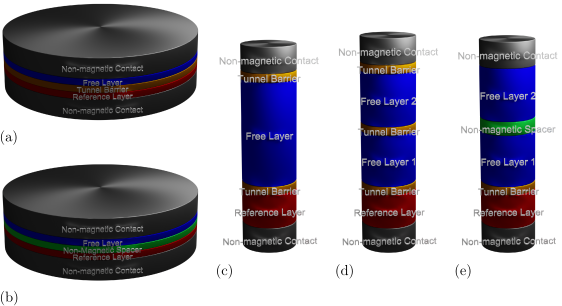
Figure 7.1(a, b) illustrates conventional MRAM cells with a lateral diameter of approximately 40nm: (a) a standard MTJ stack consisting of a 1nm RL, a 1.7nm FL, and a 1nm MgO TB, and (b) a variant employing a NMS, a 2nm metal film. Figure 7.1(c–e) show scaling concepts for ultra-scaled diameters: (c) an elongated FL with a total length of 15nm to exploit perpendicular shape anisotropy, (d) a segmented FL with three MgO layers (TB\(_1\)–TB\(_3\)) to increase the number of CoFeB\(|\)MgO interfaces and thus the interfacial PMA, and (e) a split FL separated by a NMS.
(image)

Figure 7.1: Three-dimensional renderings of (a)–(b) conventional large-diameter MTJ cells and (c)–(e) ultra-scaled 2.3nm diameter pillar geometries with different FL configurations: elongated single FL, composite two-segment FL with middle TB, and composite FL with non-magnetic metallic spacer  [182].

The investigated ultra-scaled MRAM cell (Figure 7.1) consists of a 2.3nm diameter cylindrical pillar with a 5nm CoFeB RL (magnetization fixed in \(+\hat {x}\)), a primary MgO barrier TB\(_1\) (0.9nm), a first FL segment FL\(_1\) (5nm), a middle MgO barrier TB\(_2\) (0.9nm) that boosts interfacial PMA and generates spin torque critical for sequential switching, a second FL segment FL\(_2\) (5nm), a capping MgO layer TB\(_3\) (0.9nm), and 50nm metallic contacts.

In conventional perpendicular MTJs, the anisotropy is primarily determined by the CoFeB\(|\)MgO interface adjacent to the TB. A common strategy to enhance the effective perpendicular anisotropy is therefore to introduce additional CoFeB\(|\)MgO interfaces within the FL. For ultra-scaled junctions, however, interfacial PMA alone is insufficient to maintain thermal stability. Instead, the FL can be elongated along the pillar axis so that the shape anisotropy provides a positive contribution to the perpendicular easy axis once the magnetic thickness becomes comparable to or larger than the pillar diameter. This concept of perpendicular shape anisotropy has been experimentally demonstrated for single-digit nanometer MTJs and enables current-driven switching while preserving large thermal stability factors at very small diameters  [189]. Further scaling down to a 2.3nm diameter was achieved using a composite FL separated by MgO, which yields very high thermal stability and low switching voltage due to the combined action of interfacial anisotropy, magnetostatic coupling, and spin-transfer torque  [190]. Recent experiments have extended this approach to single-nanometer MTJs with multi-interface FL designs  [86].

The present device combines these approaches. The segmentation of the FL by MgO barriers creates multiple CoFeB\(|\)MgO interfaces and thus enhances the interfacial contribution to the perpendicular anisotropy. At the same time, the increased total FL length places the device in the regime where perpendicular shape anisotropy becomes substantial, which is essential for maintaining sufficient thermal stability at a pillar diameter of 2.3nm. The intermediate MgO barrier TB\(_2\) magnetically partitions the FL and enables inter-segment spin-transfer torque, resulting in a sequential switching mechanism. The top MgO layer TB\(_3\) acts as an MgO cap that provides an additional CoFeB\(|\)MgO interface for anisotropy engineering  [191, 192]. Since it is not part of the primary RL–FL tunneling conduction path, it does not significantly increase the resistance-area product of the junction. TB\(_3\) also does not contribute significantly to STT, because the spin current polarized by the RL is attenuated by FL\(_1\) and TB\(_2\) before reaching FL\(_2\), and any residual polarization at the FL\(_2|\)TB\(_3\) interface is weak (\(P_3 = 0.2\) in the simulations). The spin polarization at each MgO barrier (\(P_1\), \(P_2\), \(P_3\)) can be independently controlled through fabrication parameters: MgO thickness governs the coherent tunneling efficiency, and annealing conditions control CoFeB\(|\)MgO interface crystallinity  [53, 69, 191]. This provides the experimental basis for treating \(P_1\), \(P_2\), and \(P_3\) as independent design parameters in the simulations.

The continuum micromagnetic approach remains valid at this scale because the exchange length \(\lambda _{\text {ex}} = \sqrt {2A/(\mu _0 M_S^2)} \approx \SI {5}{\nano \meter }\) exceeds the 2.3nm device diameter, so each FL segment behaves approximately as a macrospin.

7.3.2 Elongated FL: Domain Wall Failure

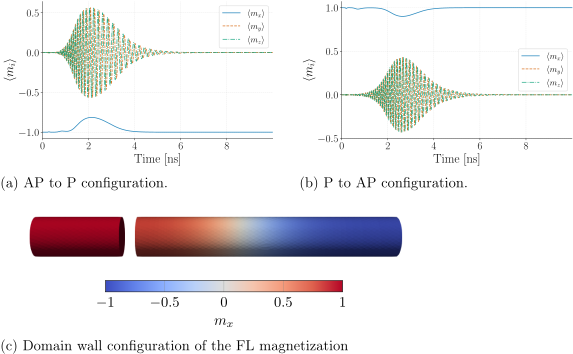
The most direct approach to thermal stability is to elongate the FL along the pillar axis, thereby supplementing interface-induced PMA with shape anisotropy. However, as Figure 7.2 shows for a 15nm single FL under ±2V bias, the spatially non-uniform STT distribution initiates a domain wall that dissolves after approximately 3ns without achieving switching, as the competing torques on either side of the wall cancel the net driving force.
(image)

Figure 7.2: Magnetization dynamics in an ultra-scaled cell with a 15nm elongated single FL (cf. Figure 7.1 (c)) at ±2V bias. (a), (b) Time evolution of magnetization components for AP to P and P to AP initial configurations showing failed switching. (c) Three-dimensional magnetization snapshot at 2ns revealing the domain wall that prevents reversal. Figures based on  [182].

This failure motivates the composite FL approach: dividing the elongated FL into shorter segments, separated by a thin spacer, suppresses domain-wall formation, enabling sequential switching.

7.3.3 Composite FL Solution

Splitting the FL into two 5nm segments overcomes the domain wall barrier. Two separator variants were investigated: a 0.9nm MgO TB and a 2nm NMS.

(image)

(a)
   

(image)

(b)
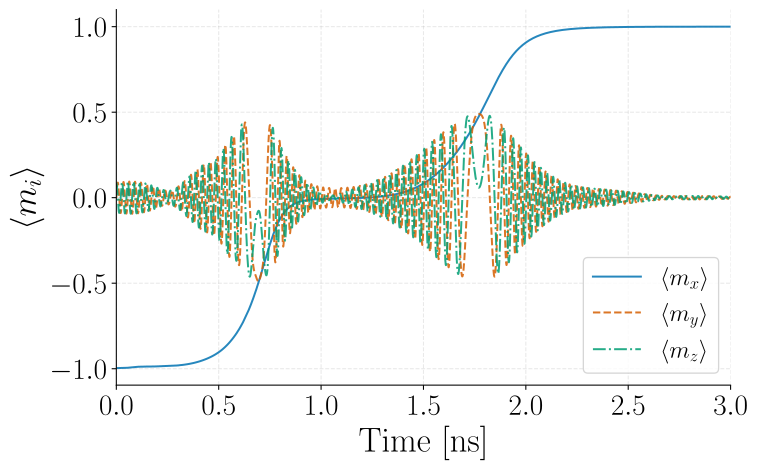
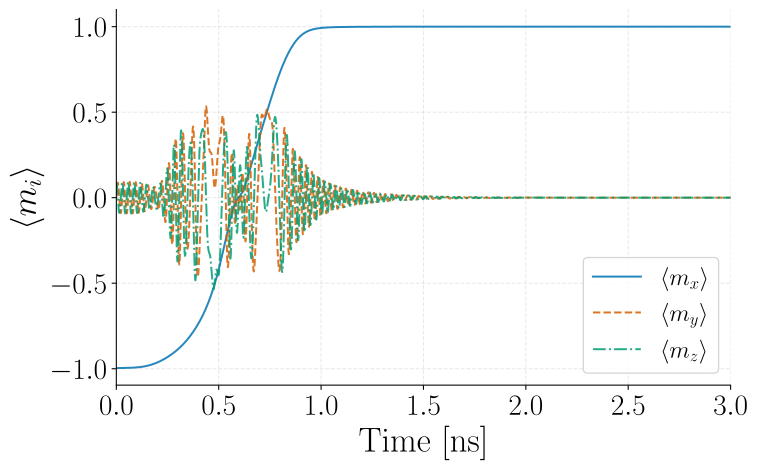
Figure 7.3: Successful switching of composite FL structures at −2V bias: (a) two 5nm FL segments separated by a 0.9nm MgO TB (cf. Figure 7.1 (d)), reaching switching after approximately 2ns, (b) two 5nm FL segments separated by a 2nm non-magnetic metallic spacer (cf. Figure 7.1 (e)), achieving switching after approximately 1ns. Figures based on  [182].

With the MgO TB separator (Figure 7.3a), FL\(_1\) reverses first, followed by FL\(_2\), switching after approximately 2ns. The NMS variant (Figure 7.3b) achieves switching approximately twice as fast (\(\sim \)1ns), because the metallic spacer permits stronger spin current transmission between the FL segments compared to the insulating MgO barrier, resulting in a larger torque driving FL\(_2\) reversal after FL\(_1\) has switched. These sub-2ns switching times at moderate bias are consistent with the experimentally demonstrated low-voltage switching in 2.3nm diameter composite FL devices  [190], and the predicted sequential reversal mechanism agrees qualitatively with the current-driven switching behavior reported for multi-interface ultra-scaled MTJs  [86, 189]. The following subsections analyze the sequential switching mechanism in detail.

7.3.4 Switching Mechanisms in Composite FLs

The two FL segments switch sequentially rather than simultaneously, with profound implications for switching speed, intermediate-state exploitation, and failure modes. The following parametric study employs a lower bias of ±1.5V for systematic model comparison.

Figure 7.3 shows that both transitions exhibit a distinct plateau at \(\langle m_x \rangle \approx 0\), corresponding to an intermediate configuration in which the two FL segments have opposite orientations.
(image)

(a)
   

(image)

(b)

(-tikz- diagram)

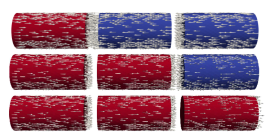
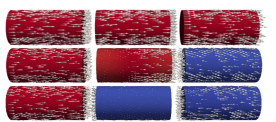
Figure 7.4: Three-dimensional magnetization snapshots of the sequential switching process in ultra-scaled composite FL cells (cf. Figure 7.1 (d)), showing initial, intermediate (plateau), and final states for (a) AP\(\to \)P and (b) P\(\to \)AP transitions. The switching order is direction-dependent: FL\(_1\) switches first in AP\(\to \)P, while FL\(_2\) switches first in P\(\to \)AP, reflecting the asymmetric torque configurations at each interface  [123].

Figure 7.4 visualizes the sequential switching process, confirming the intermediate state, where the two FL segments have opposite orientations. The torque hierarchy governing this sequential switching, why FL\(_1\) switches first in AP\(\to \)P and FL\(_2\) first in P\(\to \)AP, is analyzed quantitatively in Section 7.4.1.

7.3.5 FL Length Optimization

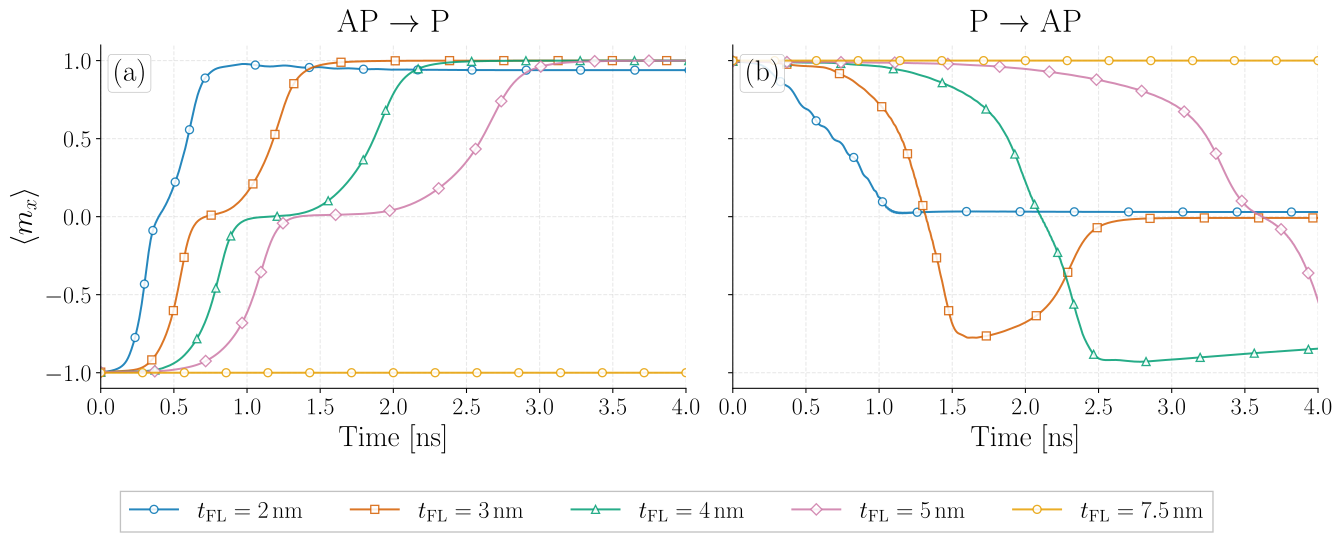
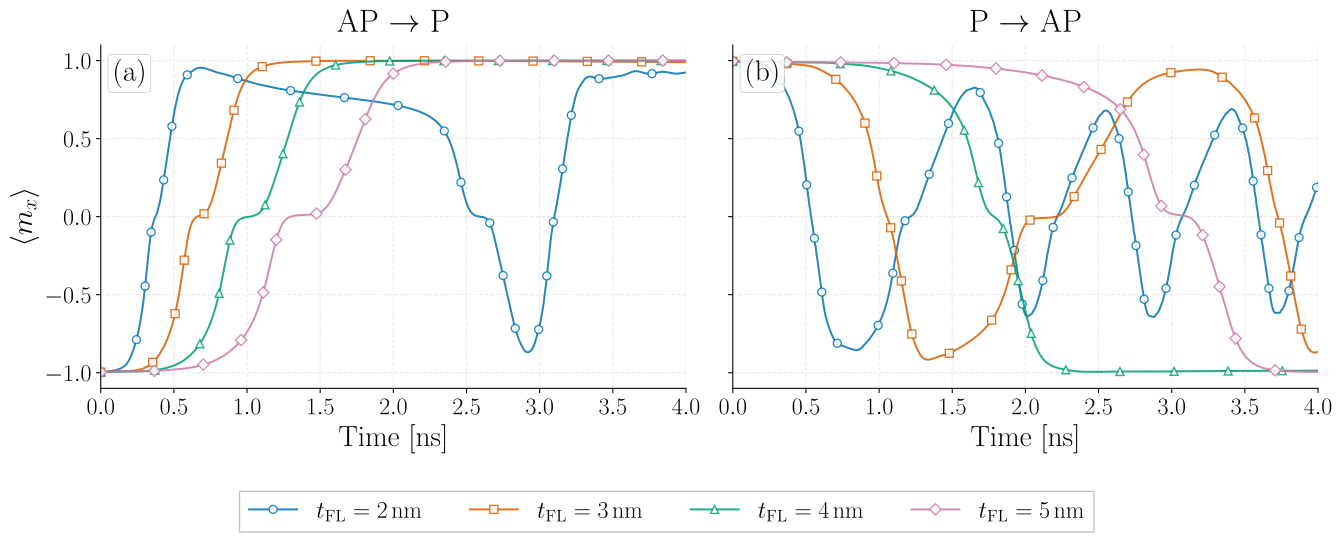
A systematic parameter study varied the FL segment length over 2, 3, 4, 5, and 7.5nm at ±1.5V bias.

(image)

Figure 7.5: Magnetization trajectories during (a) AP\(\to \)P and (b) P\(\to \)AP switching for FL segment lengths of 2, 3, 4, 5, and 7.5nm with standard polarization (\(P_1 = 0.62\), \(P_2 = 0.57\), \(P_3 = 0.2\)) and Set A material parameters (Table 7.2). Critical design constraints emerge: segments shorter than approximately 5nm exhibit back-hopping instability during P\(\to \)AP switching, because the anisotropy barrier scales with segment length (\(\mathcal {E}_{\mathrm {B}} \propto K_\text {eff} \cdot l\)) while the interfacial spin-transfer torque is approximately length-independent, so shorter segments satisfy the instability condition (7.1) more readily. Segments longer than approximately 6nm fail to complete switching at moderate bias. The optimal range of 3nm to 5nm provides reliable switching in both directions. Based on Figure  [193].

(image)

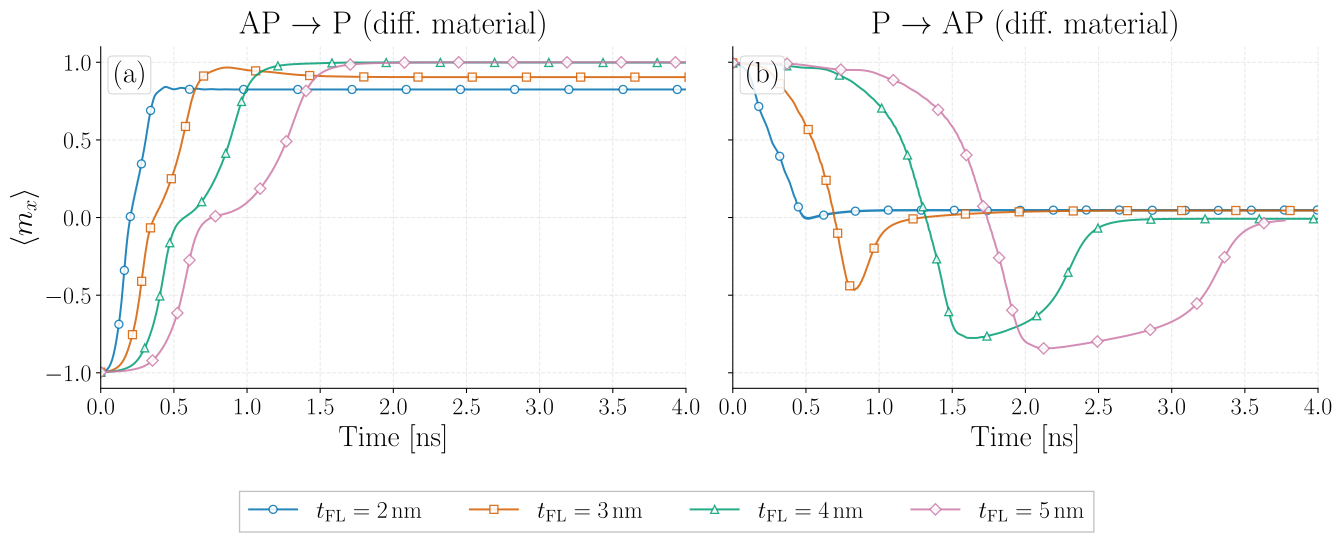
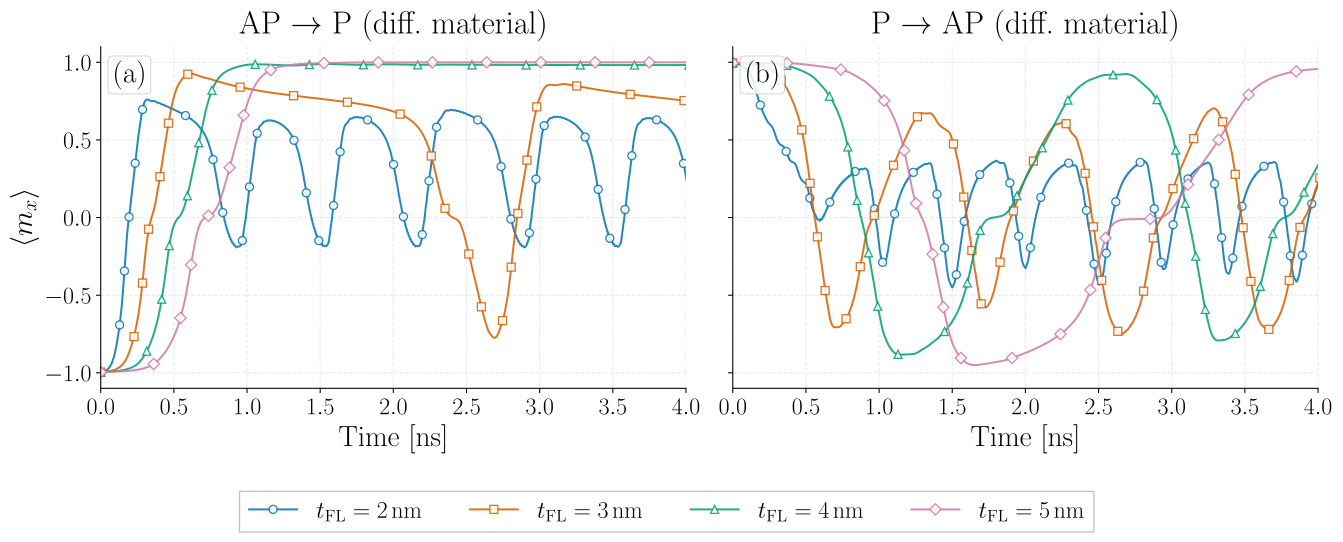
Figure 7.6: Same configuration as Figure 7.5 but with Set B material parameters (Table 7.2), confirming robustness of the FL length constraints across material parameter sets. Based on Figure  [194].

(image)

Figure 7.7: Magnetization trajectories for FL segment lengths of 2, 3, 4, and 5nm with enhanced TB\(_2\) polarization (\(P_1 = 0.5\), \(P_2 = 0.9\), \(P_3 = 0.2\)) and Set A material parameters. The enhanced TB\(_2\) polarization modifies the back-hopping thresh- old compared to the standard case (Figure 7.5). Based on Figure  [193].

(image)

Figure 7.8: Same enhanced TB\(_2\) polarization as Figure 7.7 but with Set B material parameters, demonstrating that the polarization-dependent switching behavior persists across material choices. Based on Figure  [194].

Figure 7.5 reveals several critical trends. The intermediate plateau duration at \(\langle m_x \rangle \approx 0\) increases systematically with FL length: barely visible for 2nm segments but extending for hundreds of picoseconds at 5nm. Because the anisotropy barrier scales as \(\mathcal {E}_{\mathrm {B}} \propto K_{\text {eff}} \cdot l\) while the interfacial spin-transfer torque is approximately length-independent, the characteristic switching time scales linearly with segment length, \(\tau _{\text {sw}} \propto l\).

Minimum length constraint - back-hopping: The 3nm to 4nm FL segments exhibit back-hopping during P\(\to \)AP switching, visible in Figure 7.5 (b) as a reversal after the initial transition. The back-hopping arises because the low anisotropy barrier of short segments allows the torque from the reversed FL\(_1\) to drive FL\(_2\) back after the initial switch. This deterministic back-hopping mechanism and its exploitation for multi-level cell operation are analyzed in detail in Section 7.4. Conversely, the 2nm segments demonstrate a distinct failure mode: only the FL\(_2\) layer undergoes switching, subsequently becoming locked in an intermediate state. This inability to complete the transition to the full AP configuration results in a permanent write error.

Maximum length constraint - incomplete switching: The 7.5nm segments fail to complete P\(\to \)AP switching at 1.5V, remaining locked at the initial state because the stray fields generated by the composite free layer favor the parallel alignment, effectively stabilizing the configuration and making the P state more difficult to destabilize with the available STT. In contrast, the AP\(\rightarrow \)P transition is still possible for the same 7.5nm structure, although switching occurs only after approximately 8ns, indicating significantly slower reversal dynamics. Since the switching time greatly exceeds the timescale relevant for this study, the trajectories shown in Figure 7.5 are truncated at 3ns, and this case is not further investigated.

Optimal range: The FL segment length range of 4nm to 5nm provides the optimal balance for the ultra-scaled geometry:

  • (i) Lengths below 2nm to 3nm risk back-hopping instability during P\(\to \)AP switching

  • (ii) Lengths above 5nm may fail to complete switching at moderate bias voltages

  • (iii) Intermediate lengths of 4nm to 5nm provide successful switching with adequate thermal stability. However, 4nm segments still exhibit marginal back-hopping tendencies. This behavior can be circumvented by utilizing lower bias voltages or optimizing pulse duration to ensure the device settles into the desired state before instability triggers.

These constraints are specific to the 2.3nm diameter geometry studied. Still, the fundamental trade-offs back-hopping for too-short layers and incomplete switching for too-long layers remain applicable across device dimensions.

New physical insight. The three-dimensional drift-diffusion simulations reveal that composite FLs in ultra-scaled MRAM cells switch sequentially rather than coherently, with the switching order determined by the asymmetric torque configuration at each interface FL\(_1\) first for AP\(\to \)P, FL\(_2\) first for P\(\to \)AP. This sequential mechanism, inaccessible to macro-spin models, produces an observable plateau at \(\langle m_x \rangle \approx 0\) whose duration scales with the FL segment length. The optimal segment length of 4nm to 5nm balances thermal stability (\(\Delta > 60\)) against the onset of back-hopping instability.

7.3.6 Material Parameter Robustness

To verify that back-hopping is a robust structural phenomenon rather than a material artifact, the simulations were repeated with an alternative parameter set (Set B) from the Boris Computational Spintronics database (Table 7.2): 32% lower \(M_S\), doubled \(A\), halved \(D_e\), and 20% shorter \(\lambda _J\), with identical \(K_i\) and \(\alpha \). Figure 7.7

Table 7.2: Comparison of material parameter sets used to verify robustness of the back-hopping mechanism.
.
Parameter Set A Set B Ratio
\(M_S\) [A/m] \(1.2 \times 10^6\) \(0.81 \times 10^6\) 0.68
\(A\) [J/m] \(1 \times 10^{-11}\) \(2 \times 10^{-11}\) 2.0
\(D_e\) [m2/s] \(2 \times 10^{-2}\) \(1 \times 10^{-2}\) 0.5
\(\lambda _J\) [nm] 1.0 0.8 0.8
\(K_i\) [J/m2] \(1.53 \times 10^{-3}\) 1.0
\(\alpha \) 0.015 1.0

Figure 7.6 and Figure 7.8 confirm that Set B reproduces the same directional asymmetry, FL-length dependence, and oscillation periods as Set A despite substantially different bulk transport parameters. This robustness follows from the instability condition (7.1): since \(K_i\) and the TB polarizations are identical in both sets, the onset threshold is preserved. This configuration is further validated by the dynamics shown in Figure 7.7 and Figure 7.8, which confirm that the middle barriers, referring to the tunnel barriers separating layers, dominate the switching outcome, establishing the TB polarization hierarchy as the primary design parameter for back-hopping control.

7.3.7 Switching Characteristics in Asymmetric FLs

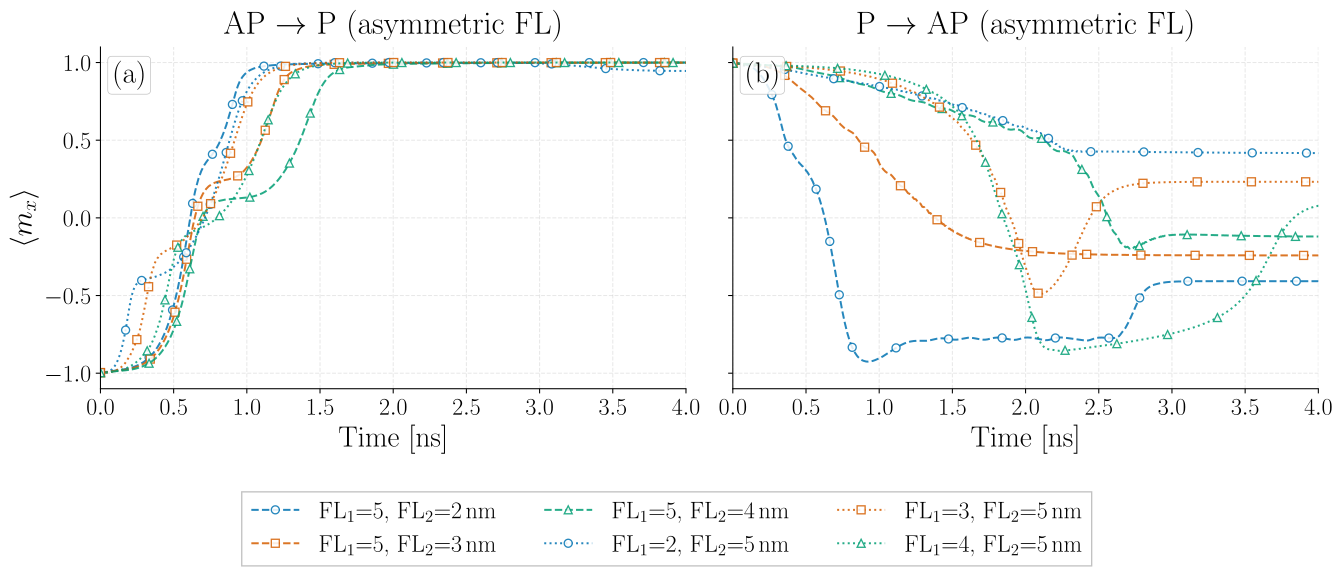
To further investigate deterministic back-hopping behavior, cells with asymmetric FL configurations are investigated. Figure 7.9 displays the magnetization trajectories for switching from AP\(\to \)P and P\(\to \)AP in which the segments of the composite FL have asymmetric lengths. In these asymmetric structures, either FL\(_1\) is fixed at 5nm while FL\(_2\) is varied (2, 3, and 4nm), or conversely, FL\(_2\) is fixed at 5nm and FL\(_1\) is varied.

Figure 7.9 (a) demonstrates that successful switching from AP\(\to \)P is always achieved regardless of the FL composition. However, Figure 7.9 (b) reveals that successful switching from P\(\to \)AP is highly dependent on the layer geometry. Successful transitions are observed only for the symmetric configuration with a length of 5nm. For asymmetrical configurations, the variations in FL\(_1\) and FL\(_2\) lengths result in distinct total magnetizations, leading to intermediate states where the cell fails to settle into the AP configuration. The differences in response times among these cells arise from their distinct uniaxial anisotropies, which scale with the layer’s length. A shorter layer has a lower energy barrier separating the two magnetization states, thereby accelerating the response time but increasing susceptibility to instability.

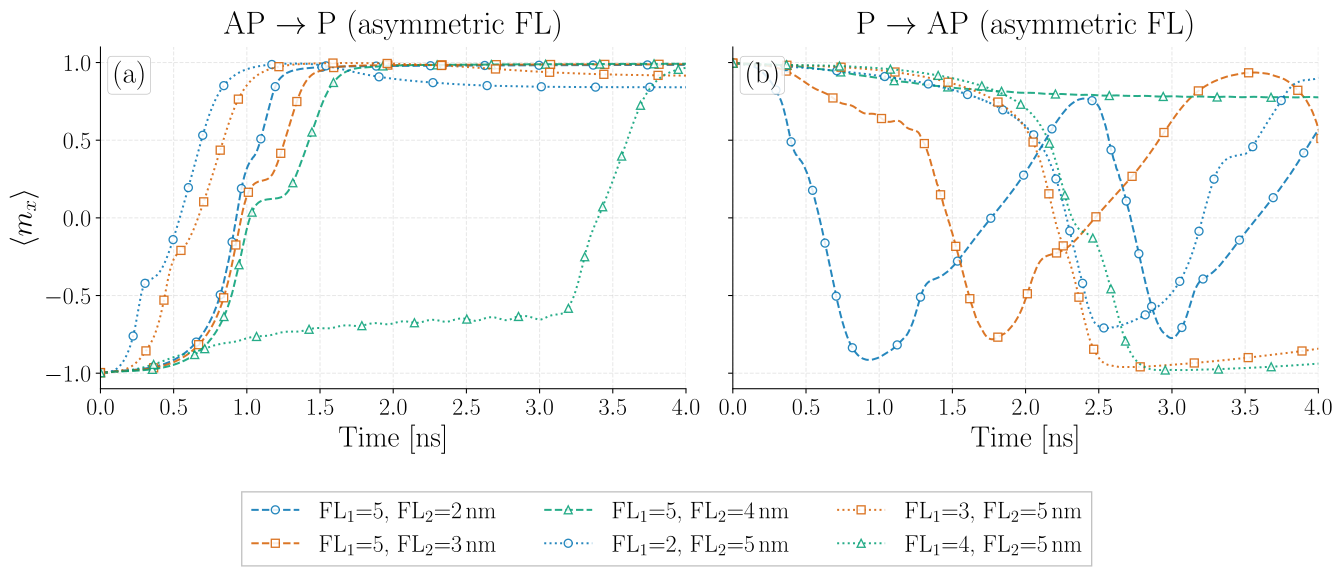
To control this instability, Figure 7.10 reports switching simulations where the polarization of the middle TB (TB\(_2\)) is enhanced. This higher TB polarization yields a larger spin current, ensuring that the inter-segment torque acting between the two FL parts is stronger than the torques originating from the RL. In Figure 7.10 (a), all structures switch successfully during AP\(\to \)P. Notably, the asymmetric structure with a 4nm FL\(_1\) and a 5nm FL\(_2\) exhibits a profoundly delayed switching initiation, remaining in a canted state (\(\langle m_x \rangle \approx -0.75\)) for over 3ns. This delay arises from a torque deadlock: because FL\(_1\) must initiate the AP\(\to \)P transition, the forward torque from the RL is heavily countered by the opposing torque from the thicker 5nm FL\(_2\), creating a backward push amplified by the enhanced TB\(_2\) polarization. Shorter segments (2 and 3nm) avoid this deadlock because their reduced energy barriers are easily overcome by the STT. Furthermore, the symmetric 5nm structure bypasses this trap entirely, due to its geometry, which prevents a larger layer from artificially pinning a smaller one, allowing it to transition smoothly and much faster (\(\sim \)2ns).

(image)

Figure 7.9: Magnetization trajectories with standard polarization (\(P_1 = 0.62\), \(P_2 = 0.57\), \(P_3 = 0.2\)) and asymmetric FL segment lengths for (a) AP\(\to \)P and (b) P\(\to \)AP switching across FL lengths of 2nm to 5nm. Based on Figure  [188].

(image)

Figure 7.10: Magnetization trajectories with enhanced TB\(_2\) polarization (\(P_1 = 0.5\), \(P_2 = 0.9\), \(P_3 = 0.2\)) and asymmetric FL segment lengths for (a) AP\(\to \)P and (b) P\(\to \)AP switching across FL lengths of 2nm to 5nm. The enhanced TB\(_2\) polarization intensifies the cyclic transitions compared to the standard polarization case (Figure 7.9), confirming deterministic back-hopping. Based on Figure  [188].

Similarly, during the P\(\to \)AP transition (Figure 7.10 (b)), the asymmetric structure with a 5nm FL\(_1\) and a 4nm FL\(_2\) demonstrates an analogous behavior. Because the torque hierarchy dictates that FL\(_2\) must initiate this reversal, the 4nm FL\(_2\) presents a substantial energy barrier compared to thinner segments. The STT struggles to destabilize this thick initiating layer against the influence of the larger 5nm FL\(_1\), significantly postponing the onset and preventing the reversal process. Consequently, the magnetization remains pinned near \(\langle m_x \rangle \approx 0.75\) for the entire time. This deterministic process repeats indefinitely as long as the bias is maintained, confirming that the middle polarization can tune or deliberately trigger cyclic instability.