

Modeling Spin-Orbit Torques
in Advanced Magnetoresistive Devices
7.4 Trilayer Spin Currents and Torques
In this section, FM/NM/FM trilayer with an in-plane electric field is considered. Adding a second FM layer below the NM layer introduces another degree of freedom to the typical bilayer system. Such CIP trilayers were first studied in the context of GMR, where the resistance of the stack depended on the orientation of the bottom FM layer relative to the upper. However, the magnetization orientation can also influence the spin currents generated in the bulk of the bottom FM layer or at the interface, allowing for additional control of the SOTs acting on the upper FM. Here, the focus will be on spin currents generated through the Rashba SOC at the bottom interface and the unconventional SOTs that can arise in the upper FM layer as a result. Parts of the results and discussions in the following two subsections were adapted from work published in Ref. [79] at the time of writing.
7.4.1 Interface Generated Spin Currents in Trilayers
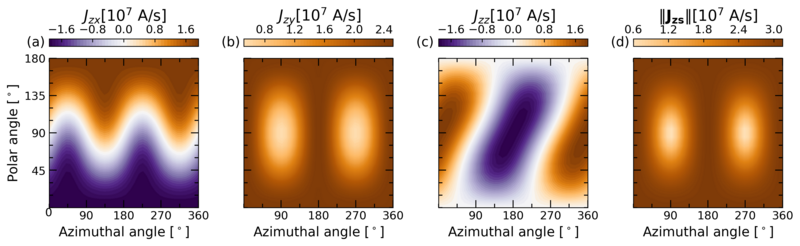
At the bottom interface in a FM/NM/FM trilayer, the SOF and SOP mechanisms generate out-of-plane spin currents that propagate through the NM layer and are capable of reaching the upper FM layer. Figure 7.16 shows the angular dependence of the spin currents generated on the NM side of a FM/NM interface through the Rashba SOC for an in-plane electric field. The interface-generated spin currents exhibit a strong dependence on the magnetization direction, with all spin polarization components attainable at comparable magnitudes. Some polarization components are more pronounced for specific magnetization orientations, allowing the spin current polarization to be tuned by adjusting the magnetization direction. A magnetization along \({\mathbin {\textpm }} z\) produces spin currents with a strong \({\mathbin {\textpm }} x\)-polarization component, while a magnetization along \({\mathbin {\textpm }} x\) yields a strong polarization component along \({\mathbin {\textpm }} z\). Reversing the charge current reverses the polarity of the out-of-plane spin currents. Due to the SOF, there is always a \(y\)-component present, while the \(x\)- and \(z\)-components arise primarily from the SOP mechanism.
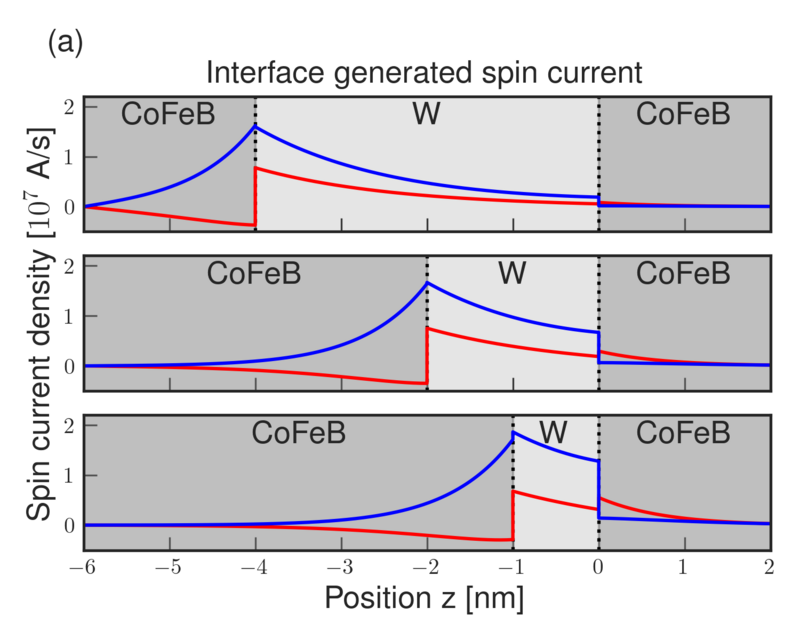
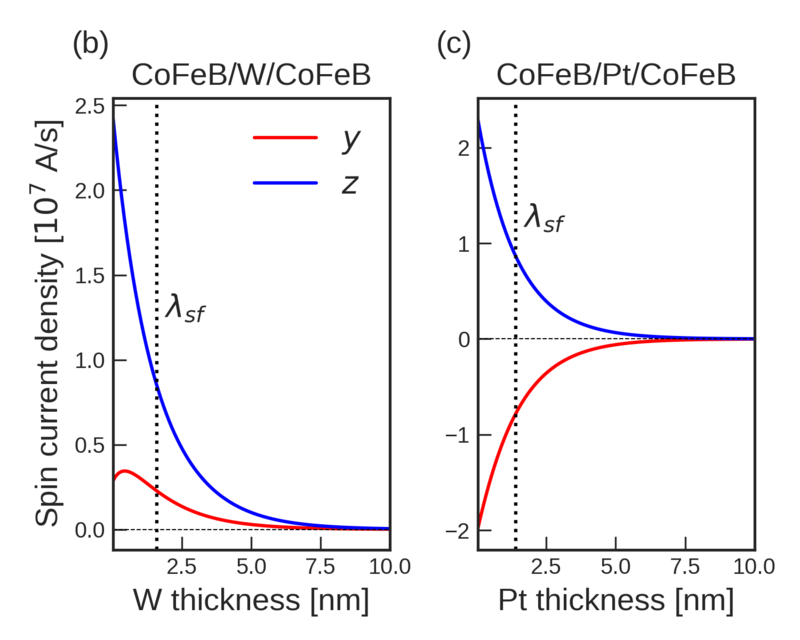
Assuming that similar behavior will be observed for the \(x\)-component when the bottom FM magnetization is along \({\mathbin {\textpm }} z\), from now on, the focus will be on the \(z\)-component of the spin current, obtained when the bottom FM magnetization is along \({\mathbin {\textpm }} x\). Figure 7.17a shows the spin currents generated at the lower FM/NM interface for various NM layer thicknesses. These spin currents originate at the bottom interface and decay across the NM layer due to bulk spin-flip scattering. As the NM thickness is decreased, a larger portion of the spin current reaches the upper NM/FM interface. Figures 7.17b and 7.17c display the spin currents at the upper interface computed for a CoFeB/W/CoFeB and CoFeB/Pt/CoFeB trilayer, respectively, as a function of the W and Pt thickness. For both systems, the \(z\)- and \(y\)-polarized components significantly increase as the NM spacer becomes thinner. In the CoFeB/W/CoFeB structure, the \(z\)-component is the most dominant, whereas in the CoFeB/Pt/CoFeB system, the \(y\)- and \(z\)-components are comparable in magnitude. Maximizing the torque contribution from these interface-generated spin currents therefore requires the NM spacer thickness to be smaller than \(\lambda _{sf}\), which is in counter to the requirements for enhancing the DL torque contribution from the SHE.
7.4.2 Unconventional Trilayer SOTs
As the thickness of the NM spacer in a CIP FM/NM/FM trilayer is reduced, the torque on the magnetization of the upper FM layer resulting from the spin currents generated from the bottom FM/NM interface can become comparable to or even larger than the conventional bilayer contribution. As these torques can have a different polarization direction (depending on the bottom FM magnetization), compared to the conventional bilayer polarization \(\bm {p} \| \bm {E}\times \bm {z}\), the direction of the polarization and thus the DL and FL torques is modified.
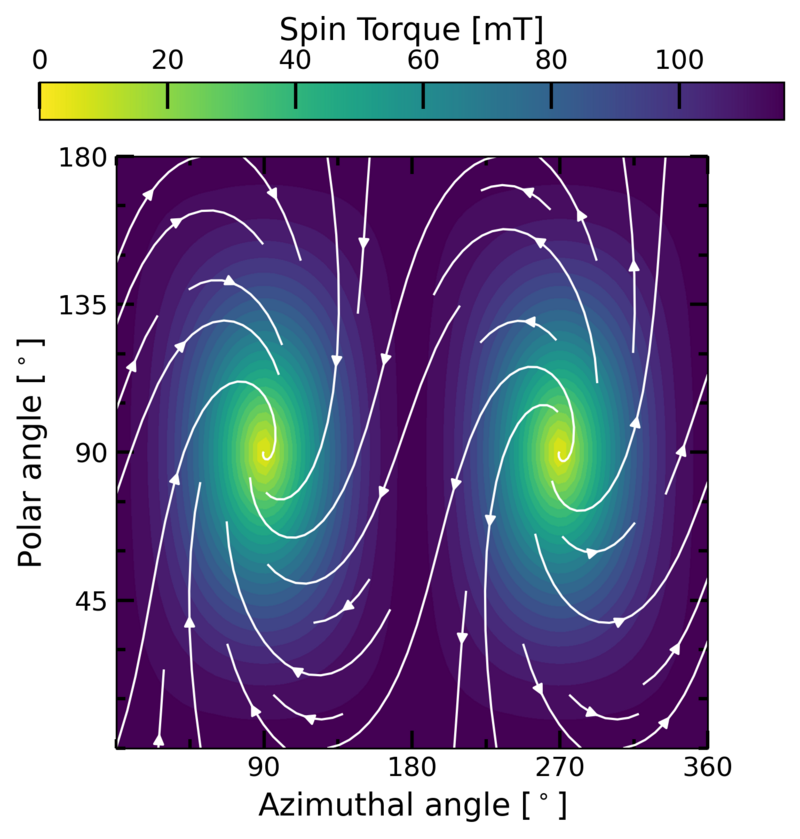
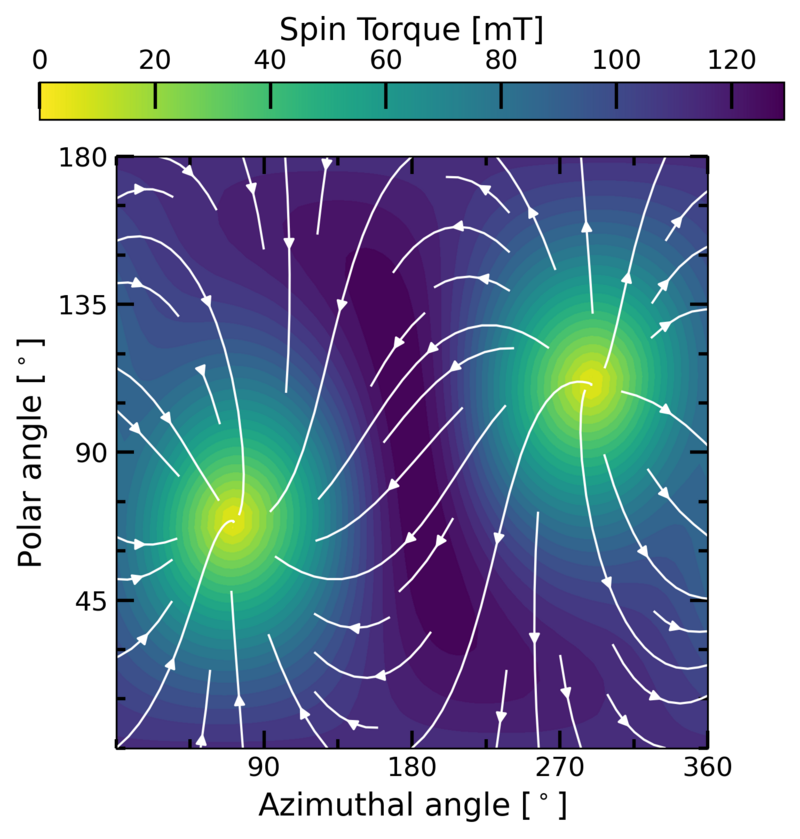
Figure 7.18a shows the full angular dependence of the SOTs in a bilayer. The two minima, where the torques vanish, correspond to the magnetization directions along \({\mathbin {\textpm }} \bm {p} = \mp \bm {y}\). The streamlines indicate the direction of the torque for different magnetization directions, which show that the torques always act to align the magnetization with \(\bm {p}\). Therefore, deterministic in-plane magnetization reversal can be easily achieved for a bilayer when the uniaxial magnetic anisotropy is along the \(y\)-axis. When the current-induced torques are sufficiently strong to overcome the energy barrier, the magnetization switches from \(y\) to \(-y\) or vice versa, depending on the current direction. However, switching a FM with a perpendicular anisotropy between \(+z\) and \(-z\) is non-deterministic, as the bilayer torques always act to bring the magnetization along \({\mathbin {\textpm }} y\). Thus, once the current is turned off, the magnetization will relax to either \(+z\) or \(-z\) with equal probability.
The full angular dependence of the SOTs in a FM/NM/FM trilayer is shown in Fig. 7.18b, where the bottom FM magnetization is fixed along the \(+x\) direction. The torque magnitude is enhanced as additional spin current from the bottom interface contributes to the total torque. Moreover, the minima are shifted away from \({\mathbin {\textpm }} y\) due to the z-polarized spin currents, indicating that the torques now act to align the magnetization with a direction that has both \(y\)- and \(z\)-components. If the upper FM has a perpendicular magnetic anisotropy, it can now be deterministically switched, as the torques will bring the magnetization away from the \(z\)-axis towards a direction in the \(y\mathrm {-}z\) plane. Once the current is turned off, the magnetization will relax to either \(+z\) or \(-z\), depending on which side of the \(x\mathrm {-}y\) plane it is located.
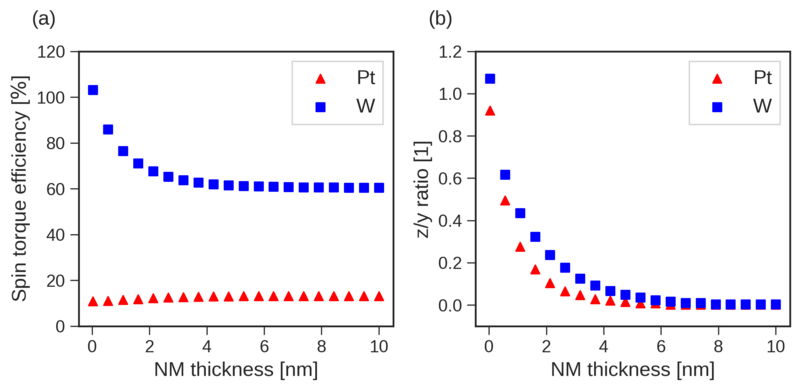
Figure 7.19 shows the total spin torque efficiency:
\(\seteqnumber{0}{7.}{8}\)\begin{equation} \xi _{\mathrm {SOT}} = \sqrt {\xi ^2_{\mathrm {DL}} + \xi ^2_{\mathrm {FL}}}, \end{equation}
and the ratio of the \(z\)- and \(y\)-polarization components:
\(\seteqnumber{0}{7.}{9}\)\begin{equation} R_{zy} = \frac {p_z}{p_y}, \end{equation}
at the upper NM/FM interface as a function of the NM spacer thickness. For each thickness, the full angular dependence of the torque is calculated, allowing for the torque efficiency \(\xi _{\mathrm {SOT}}\) and the polarization \(\bm {p}\) to be determined from the minima and maxima of the torques, respectively. The results indicate that, in contrast to bilayers, the torque efficiency in trilayers can either be maintained or significantly increased as the NM spacer thickness is reduced. This is due to the torque contribution from the interface-generated spin currents reaching the upper interface when the NM layer is sufficiently thin. The ratio \(R_{zy}\) also increases as the NM layer becomes thinner, indicating that the \(z\)-polarized component becomes more dominant. For a W spacer, \(\xi _{\mathrm {SOT}}\) exceeds \(100\%\) for a vanishing thickness, while for Pt it stays constant at \(\approx 15\%\). However, for both the \(z\mathrm {-}y\) ratio rapidly increases, reaching \(R_{zy} \approx 1\) for a vanishing thickness. These findings are highly promising; however, it should be noted that the model employed here is highly idealized, and the fits obtained for the W/CoFeB and Pt/CoFeB bilayers in Section 7.2 extrapolate the ultra-thin NM limit. Furthermore, in this limit, many of the model assumptions break down. Nevertheless, a recent experimental study reports a similar enhancement of the SOT efficiency for a decreased NM spacer thickness [131], lending support to these results.
For the miniaturization of SOT-MRAM, switching between the \(x\) and \(z\) magnetization states is particularly desirable, as it eliminates the need to widen the stack for reliable magnetization pinning. The shape anisotropy of the SOT track can stabilize a magnetization along \(x\), while a \(z\)-oriented state can benefit from the perpendicular interfacial anisotropy. The interface-generated spin currents can potentially enable field-free switching for sufficiently thin NM SLs. In such a configuration, an \(x\)-type MTJ would require the bottom FM magnetization to be oriented along \({\mathbin {\textpm }} z\), whereas a \(z\)-type MTJ would require a magnetization along \({\mathbin {\textpm }} x\). Reliable field-free switching of a perpendicular magnetization state in an FM/NM/FM trilayer was first demonstrated by Baek et al. [132], where the bottom FM magnetization was aligned with the current direction, and the perpendicular switching was attributed to SOF and SOP effects. Later, Ryu et al. showed that the switching efficiency could be further enhanced by tilting the bottom-layer magnetization [133], thereby exploiting all three components of the spin polarization. More recently, micromagnetic simulations have demonstrated that CIP-trilayer-generated out-of-plane polarized spin currents can be harnessed to induce large-amplitude GHz oscillations in SHNOs without requiring any external bias field [134]. These oscillations were found to be self-sustained even for ratios of \(z\)- to \(y\)-polarized currents as low as \(4\%\). While these findings are highly promising for spintronic oscillator applications, experimental verification of such oscillations has yet to be demonstrated.
In addition to FM/NM/FM trilayers, several bilayer systems employing materials beyond conventional HMs for spin current generation have been reported to exhibit large unconventional torques originating from both bulk and interfacial mechanisms. For instance, Weyl semimetals such as TaIrTe\(_4\) [135], as well as collinear and non-collinear AFMs such as epitaxial FeSn and Mn\(_3\)Sn [136, 137], respectively, can generate out-of-plane polarized spin currents within their bulk, giving rise to unconventional torques in adjacent FM layers. Similarly, interfaces between Py and the insulator EuS [138], or between Py and the non-collinear AFM \(\gamma \)-IrMn\(_3\) [139], have been shown to produce large out-of-plane spin-polarized currents and corresponding unconventional torques. The spin drift-diffusion model can be extended to account for such bulk contributions by modifying the spin Hall conductivity tensor to include \(z\)-polarized spin currents, which have been shown to enable field-free switching [140]. Incorporating the reported interfacial contributions, however, would require the inclusion of an \(x\)-polarized in-plane spin current within the NM layer, which could give rise to unconventional torques via SOP and the SREE, or alternatively, through a distinct form of interfacial SOC beyond the Rashba SOC considered in this work.